EN
 AR
 CS
 DA
 NL
 FI
 FR
 DE
 EL
 HI
 IT
 JA
 KO
 NO
 PL
 PT
 RU
 ES
 SV
 ID
 SK
 SL
 ET
 TH
 TR
 MS
 KA
 UR
 BN
 MN

How to Combine Style and Function with Custom RFID Leather Wristbands
A leather wristband can look like a considered brand object rather than a disposable credential. That is precisely why it deserves more planning than a color choice and a logo file. When specifying a custom programmable rfid bracelet, buyers need to connect the visible layer—leather finish, edge treatment, hardware, and artwork—to the less visible layer of chip selection, inlay placement, encoding, and reader compatibility. A polished band that scans inconsistently is not a successful design; neither is a reliable credential that clashes with the guest experience.
From an OEM/ODM manufacturing perspective, the useful question is not “Can this be made?” It is “What must be decided together so the finished wristband looks intentional and works at the point of use?” That framing makes a custom programmable rfid bracelet easier to specify, sample, and deploy.
Start with the job the bracelet must perform
Before choosing leather color or a rfid bracelet custom print treatment, define the operating task. Is the band an access credential for a private club, a reusable guest identifier at a resort, a membership token, or a branded item for a controlled event? The answer affects the appropriate chip family, memory configuration, expected read distance, closure style, and level of wear resistance.
A custom programmable rfid bracelet is not automatically an NFC product, a long-range UHF product, or a universal replacement for existing cards. For many HF access-control deployments, a chip and reader arrangement based on the ISO/IEC 14443 proximity-card family may be relevant, but compatibility should be confirmed against the actual reader system before production. Treat “programmable” as a workflow requirement: clarify who supplies identifiers, what data is encoded, whether sequential numbering is needed, and how verification will be performed.
- Access control: prioritize chip-reader compatibility, scan consistency, and secure identifier handling.
- Membership or loyalty: balance a premium tactile experience with repeat-wear durability and a clean visual hierarchy.
- Event activation: plan the artwork for fast recognition while validating gate throughput under realistic reader settings.
Let the leather design support the RFID architecture
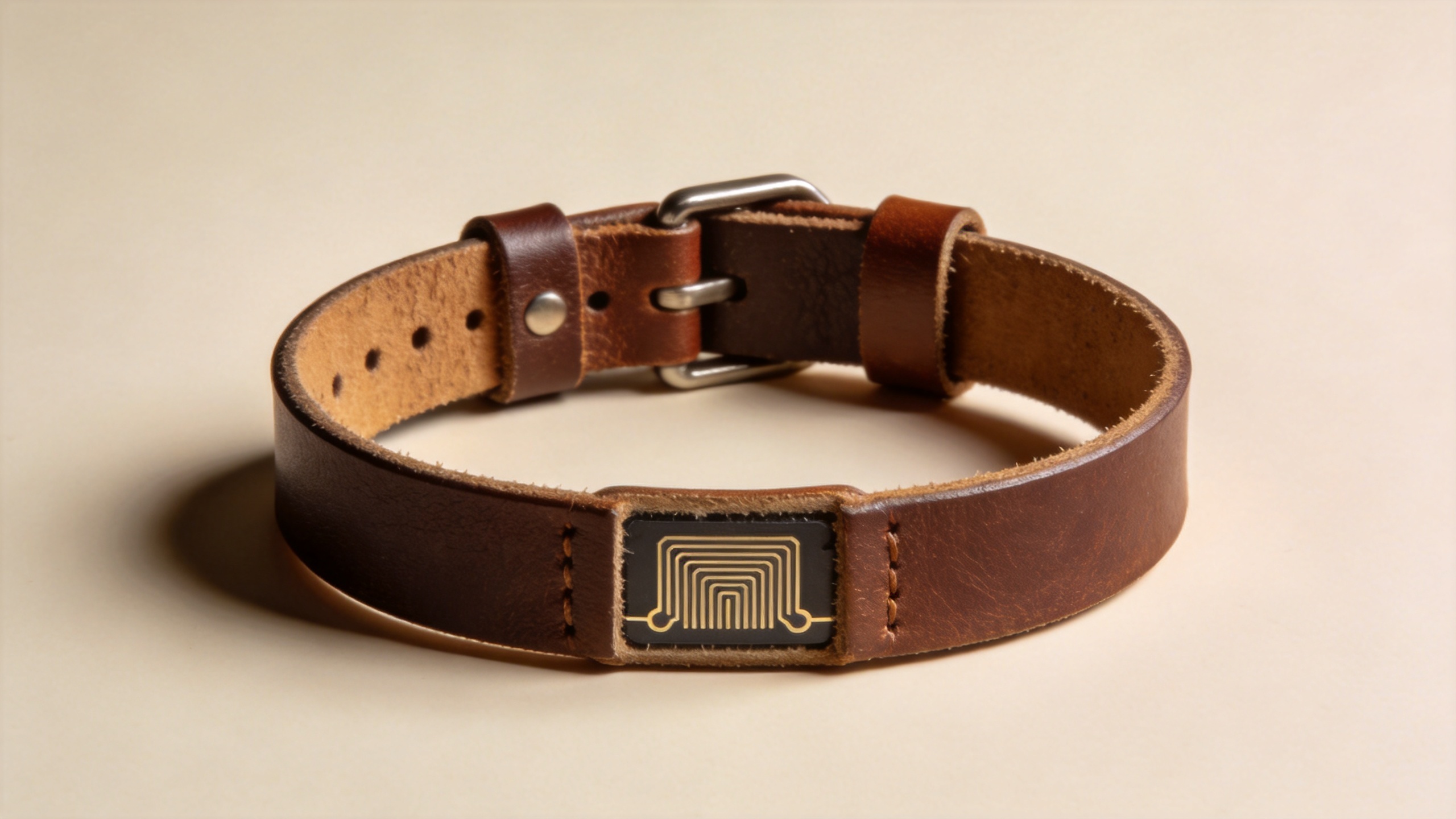
Leather changes the perceived value of a wristband, but it also changes the design conversation. Thickness, backing materials, stitching, rivets, metal closures, and decorative layers should be reviewed with the inlay layout in mind. RFID performance depends on several variables together: chip type, antenna design, reader configuration, interference, placement, and the live deployment environment. A custom programmable rfid bracelet should therefore be evaluated as a complete assembly, not as a leather strip with an RFID component added late in the process.
Metal details can be visually appealing, for example, but should not be positioned casually near the inlay. Likewise, an oversized embossed mark may compete with the area reserved for a smooth, protected chip module. The practical solution is often a design map that marks the branding zone, the inlay zone, the flex points, and the closure zone before artwork approval.
For buyers comparing finishes, a matte surface can suit understated hospitality branding, while a more textured or contrast-stitched finish can create a stronger souvenir effect. Neither choice improves RF performance on its own. The custom programmable rfid bracelet still needs an inlay placement that has been checked with the intended reader and wearing orientation.
Build rfid bracelet custom print around legibility and wear
Good decoration does more than place a logo on the band. A thoughtful rfid bracelet custom print plan considers viewing distance, contrast, recurring brand elements, variable information, and the likelihood of abrasion. On a leather wristband, restrained graphics often remain readable longer than dense artwork squeezed into a narrow panel.
Choose the print or personalization method based on the desired visual effect and the finish being used. A rfid bracelet custom print may include a logo, event edition, serial reference, member tier, or a short call to action. Keep variable data away from fold lines and closure hardware. If a QR code or printed number is included, test it after the wristband is bent and worn—not just on a flat artwork proof.
One common procurement lesson is that print quality and closure durability can pull in different directions. A delicate finish may be attractive for a short campaign, whereas a longer-use credential needs design choices that acknowledge rubbing, sweat, flexing, and handling. Ask for a physical sample that represents the actual leather, decoration, inlay location, and closure rather than approving each element separately.
Specify programming before the production run
The word “programmable” can conceal important decisions. For each custom programmable rfid bracelet, create an encoding brief that identifies the chip model, credential format, source of the data, memory blocks or identifiers to be written, locked-data requirements where applicable, and the test procedure. The brief should also identify whether the wristbands will arrive blank, pre-encoded, or encoded in batches against a provided data file.
This is where specialist RFID support matters. A supplier with chip-selection and encoding capability can help translate an operational request into a production-ready instruction set, but the buyer should retain responsibility for authorizing the data format and reader compatibility. A small pilot can catch an ambiguity that a visual proof cannot: the wrong chip type, an unexpected identifier format, or a scan behavior that changes at the installed reader.
- Confirm the reader ecosystem and the required credential behavior.
- Approve leather, hardware, size, and rfid bracelet custom print artwork alongside the inlay layout.
- Validate a sample with representative readers, orientation, and operating conditions.
- Approve the encoding file and an acceptance method for a defined production sample.
- Document the approved specification for repeat orders.
Use sampling to protect both brand and operations
Sampling is not a formality for a custom programmable rfid bracelet. It is the moment to check whether the visual promise and functional promise meet in the same object. Inspect edge finishing, logo sharpness, closure comfort, and the way the leather ages after repeated flexing. Then run scan tests using the actual reader configuration, because reader settings and surrounding materials can influence results.
For a multi-day program, also consider how the rfid bracelet custom print will appear after routine contact with clothing, tables, bags, and skin. A wristband that remains recognizable can strengthen brand recall after the event; a design that becomes hard to read can create avoidable service friction.
Choose a supplier conversation that joins both disciplines
When requesting quotations, give suppliers more than a logo and quantity. Share the application, reader environment, target delivery date, desired leather appearance, closure preference, and encoding expectations. Direct factory communication can reduce the chance that the visible design is approved while the technical requirement remains vague. It also makes it easier to coordinate a custom programmable rfid bracelet sample with practical programming and inspection steps.
The desired result is neither the most decorative wristband nor the most technical-looking one. It is a credential that fits the brand, feels appropriate on the wrist, and behaves predictably in the workflow it was purchased to support. By treating design, material construction, rfid bracelet custom print, and programming as one specification, buyers can turn a leather RFID wristband into a useful and memorable touchpoint.