EN
 AR
 CS
 DA
 NL
 FI
 FR
 DE
 EL
 HI
 IT
 JA
 KO
 NO
 PL
 PT
 RU
 ES
 SV
 ID
 SK
 SL
 ET
 TH
 TR
 MS
 KA
 UR
 BN
 MN

Are Disposable RFID Vinyl Wristbands Cost-Effective for One-Day Events?
For a one-day festival, conference, fundraiser, or campus open day, the lowest-priced wristband may not deliver the lowest total event cost. Event teams need to compare the full operating cost: admission control, replacement handling, fraud exposure, payment flow, staffing, and the work required after gates close. Disposable RFID wrist bands can be cost-effective when a single credential replaces several manual steps without creating a recovery and sanitation program for reusable stock.
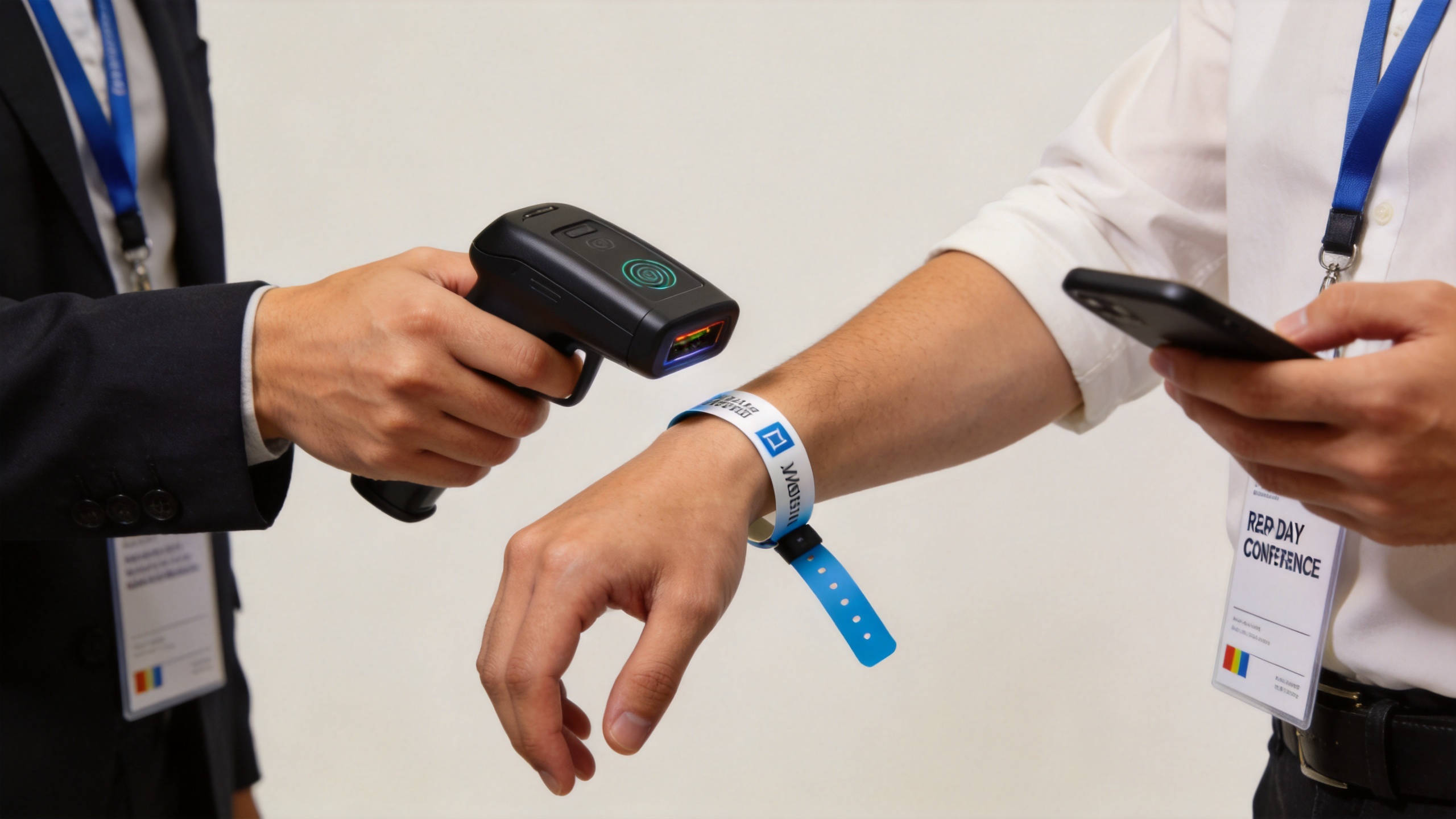
For an event buyer, a more useful question is: what does it cost to process each admitted guest? A vinyl RFID wristband is a single-use credential with an embedded chip. When matched to the venue’s readers and software, it can identify a ticket holder, support access rules, and in some deployments work as a pvc nfc payment bracelet for closed-loop or connected cashless experiences.
Start With the Right Cost Comparison
Compare options over the actual event window. A reusable band may have a higher purchase price, but it can be used again only if it is collected, inspected, cleaned, stored, and redeployed. Those tasks are often impractical when attendance is high, guests leave through multiple exits, or an event has no controlled return point. Disposable RFID wrist bands shift that work away from post-event recovery and toward a predictable per-attendee consumable.
| Cost area | Disposable RFID vinyl approach | What to verify |
|---|---|---|
| Credential purchase | One unit per attendee, plus a sensible spare allowance. | Chip type, print, encoding, quantity break, and delivery schedule. |
| Gate operations | Tap or scan can reduce manual list checks when the reader workflow is ready. | Reader capacity, offline behavior, lane design, and staff training. |
| Lost or damaged bands | Replacement can be controlled by deactivating the old credential and issuing a new one. | Identity-verification procedure and spare-band stock. |
| After-event work | No collection, cleaning, sorting, or storage program is required. | Local disposal expectations and event sustainability plan. |
A market result retrieved for this topic gives an illustrative—not universal—bulk range: basic disposable wristbands may be under US$1 each, while reusable or highly customized versions may range around US$2–5. Treat any public range as context only. Actual quotes depend on the chip, memory, print coverage, personalization, encoding, security requirements, order volume, and freight.
When Disposable RFID Wrist Bands Can Make Financial Sense
1. You need fast, visible admission control for one date
A one-day event has little time to recover from a slow entrance. Disposable RFID wrist bands make the attendee credential visible while allowing a reader to check authorization. That can be useful for tiered access, staff-only zones, age-restricted areas, VIP areas, and re-entry rules. The value depends on the operating plan: place readers where queues form, define exception handling, and test credentials before doors open.
2. Collection would cost more than reuse saves
Reusable bands may suit events where guests reliably return them or when the operator controls the full customer journey. At a public event, collection bins, deposits, staff time, cleaning, loss, and inventory reconciliation can erase the expected reuse advantage. For a short event with no practical return mechanism, a single-use vinyl band often produces a simpler and more predictable budget.
3. The wristband supports more than entry
Retrieved event-industry material commonly describes RFID credentials for access control, ticketing, cashless payments, and guest management. If the same disposable credential supports two or more planned workflows, its higher unit cost relative to a plain visual band may be easier to justify. For example, a pvc nfc payment bracelet configuration can be useful only when its NFC technology, reader hardware, payment platform, and data rules are already compatible.
When a Plain Wristband May Be the Better Buy
Do not add RFID merely because it is available. A simple visual wristband may be more economical when entry volume is low, the event has one uncomplicated admission category, no cashless or tracking workflow is planned, and staff can check tickets quickly without a bottleneck. RFID also adds setup work: chip selection, unique-ID management, encoding, reader configuration, testing, and a plan for network interruptions.
Likewise, do not promise payment capability from a chip label alone. A pvc nfc payment bracelet is a credential format, not a payment system by itself. Confirm whether the application needs NFC or another RFID frequency, which chips and identifiers the readers accept, who owns the payment data, how balances or refunds are handled, and what happens if a device loses connectivity.
A Practical One-Day Event Break-Even Checklist
- Map the attendee journey. List every point where a guest shows a ticket, enters a restricted zone, pays, receives a benefit, or re-enters.
- Estimate manual handling. Include gate staff, queue management, cash handling, wristband replacement, and post-event reconciliation.
- Specify the credential. Decide vinyl format, closure style, chip protocol, print data, serial number, and whether encoding is required.
- Validate system compatibility. Test a small encoded batch against the exact readers and event software before committing to production.
- Price the complete workflow. Compare bands, readers, software, connectivity, staffing, contingency stock, and disposal—not just the unit price.
- Set a fallback plan. Document manual entry verification, replacement approval, and outage handling before event day.
How to Source Without Creating Avoidable Costs
Give the supplier a clear brief: event date, estimated attendance, wrist size needs, expected use duration, reader or platform requirements, design files, numbering or encoding requirements, delivery destination, and testing milestones. Ask for a sample or pre-production confirmation when compatibility is important. Chengdu Mind IOT Technology’s site profile identifies its focus as RFID, NFC, UHF, PVC, and event wristband products; use that kind of product-category alignment as a starting point for a technical discussion, then validate the exact specification for your deployment.
For a one-day event, disposable RFID wrist bands are most cost-effective when they remove a measurable operational burden: a slow gate, repeated ticket checks, cash handling, or unauthorized access. They are less compelling when they become an unused layer of technology. Start with the operating problem, validate the technical fit, and compare the full event cost before choosing a single-use RFID vinyl solution.