EN
 AR
 CS
 DA
 NL
 FI
 FR
 DE
 EL
 HI
 IT
 JA
 KO
 NO
 PL
 PT
 RU
 ES
 SV
 ID
 SK
 SL
 ET
 TH
 TR
 MS
 KA
 UR
 BN
 MN

What Security Features Do RFID Festival Wristbands Offer for Large Crowds?
For a crowded festival, entry security is rarely one feature or one gate. It is a chain: a durable credential on the attendee’s wrist, a reader that recognizes it, access rules that make a decision, and staff who can handle exceptions without creating a bottleneck. That is where event security wristbands based on RFID can help. They can turn an attendee credential into a quick, configurable check at entry points, staff areas, age-restricted zones, VIP spaces, and cashless or credentialed services where those functions are part of the event system.
The important qualification is this: an RFID wristband is not automatically “secure” simply because it scans. Security depends on the chip type, the reader and software configuration, the issuing workflow, the physical construction, and the incident plan. A well-designed deployment layers these controls so that a copied-looking band, a transferred band, or a credential with the wrong permissions does not receive the same treatment as a valid attendee credential.
How to evaluate the security stack before opening day
For event security wristbands, the buying decision should start with the operating model rather than a color, chip label, or print design. Ask the access-control provider to show the exact sequence from credential issue to scan decision: what identifier is presented, where its status is checked, what happens when the network is unavailable, and which staff members can override a denial. A short, controlled gate test is more useful than an assumption based on a sample band.
In a large crowd, a denial is not automatically evidence of fraud. It could result from an unreadable presentation, a recently changed permission, a wrong entrance, a damaged closure, or a reader problem. Good event security wristbands programs give front-line staff a simple response: direct the guest to a resolution point, preserve the queue, verify the credential in the platform, and make a logged replacement or escalation decision. That protects both legitimate attendees and the integrity of restricted zones.
The supplier and organizer should agree on what is encoded, how encoding is verified, and how unused or defective bands are controlled. For tamper proof rfid wrist bands, inspect samples after stretching, moisture exposure, and normal removal attempts. The goal is not a dramatic claim that a band cannot be defeated; it is a design that gives staff visible evidence and gives the system a reliable credential to evaluate.
1. A unique credential supports faster authorization decisions
At its core, event security wristbands can carry or point to a unique identifier. When a guest presents the band to a compatible reader, the access-control platform can check whether that credential is active and whether it is permitted at that location. That makes event security wristbands useful for separating general admission, crew, vendors, performers, media, VIP guests, and age-restricted visitors without relying on staff to interpret a printed color alone.
A useful way to think about this is permission by zone and time. A crew credential may work at a production entrance during setup, while a general-admission credential works only at public gates during show hours. If a wristband is reported lost, the operator can disable that credential in the system and issue a replacement under a controlled process. Exact behavior depends on the event platform, but this central ability to activate, deny, and reissue credentials is one of the practical security advantages of RFID.
2. RFID can make credential sharing harder to manage
Traditional printed bands provide a visible cue, but event security wristbands do not independently confirm that the wearer is using an active credential unless their RFID system is checked. RFID adds a system check. A reader can be configured to reject an inactive, expired, duplicate, or wrong-zone credential, and gate staff can follow a defined exception process instead of making a rushed judgment in a queue.
For large crowds, strong results come from pairing the digital check with physical controls. A one-time locking closure, a breakaway or visibly damaged removal point, and a band material suited to the event duration can make transfer attempts easier to spot. In that sense, tamper proof rfid wrist bands should be understood as tamper-evident components of a broader process: physical evidence may indicate removal or alteration, while the RFID system handles authorization. No wristband design alone eliminates every possibility of transfer or misuse.
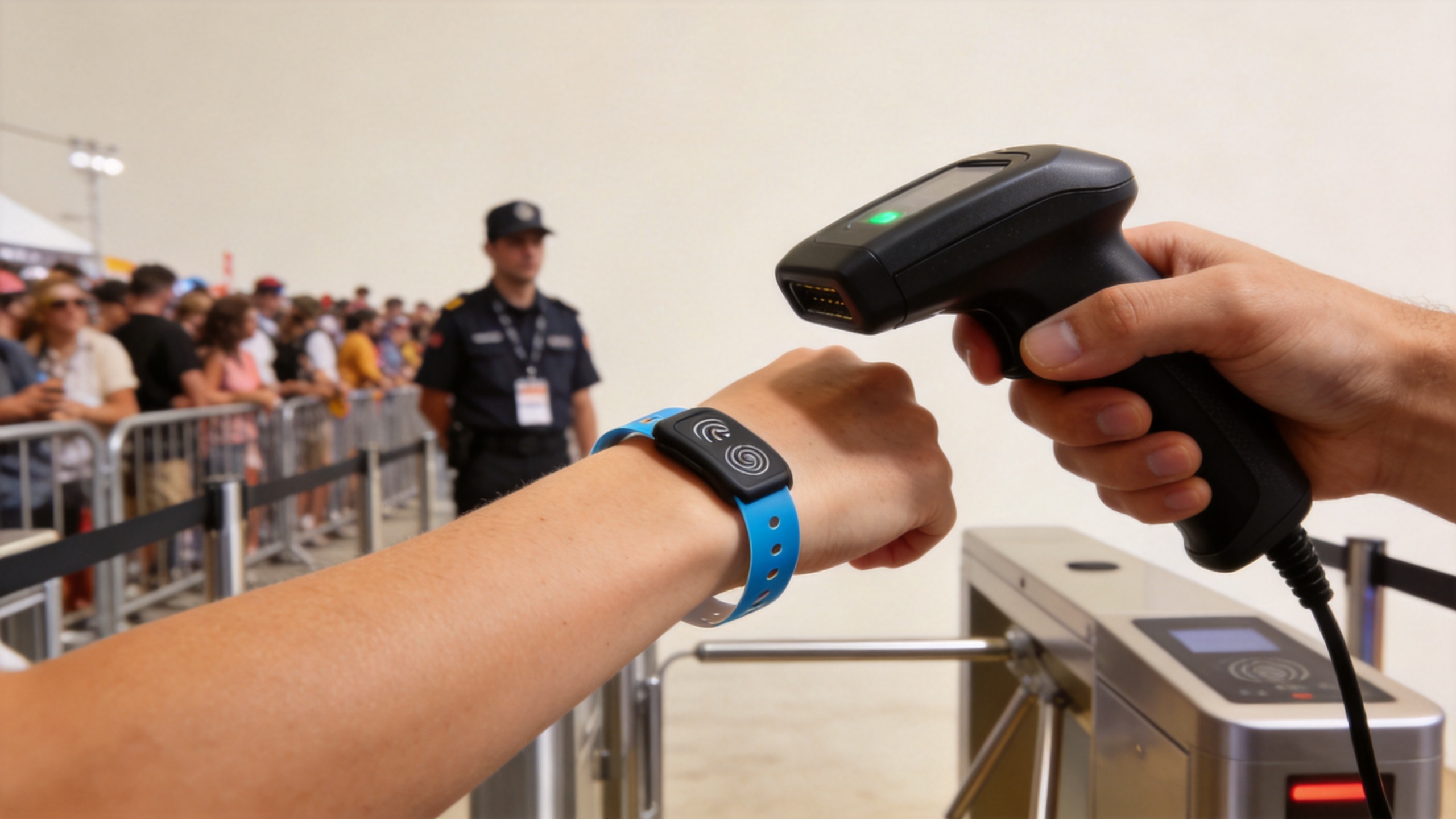
3. Chip and system choices can add technical safeguards
Not every RFID chip used in event security wristbands offers the same capabilities. Depending on the selected technology and the access-control ecosystem, an organizer may use protected commands, memory-access controls, authentication features, or secure credential handling. These capabilities should be verified during procurement and integration rather than assumed from a generic “RFID” label.
For example, a secure implementation may avoid storing sensitive personal details directly on the wristband. Instead, the band can present a credential reference while the event system makes the authorization decision using its controlled records. The team should also define who can issue credentials, who can change permissions, and who can export attendee data. This limits the effect of a lost device or an overly broad staff account.
4. Real-time status controls support loss, theft, and exception handling
Large festivals need a response path for lost event security wristbands, guest complaints, staff changes, and suspected misuse. RFID-based event security wristbands can support that workflow because each credential can have a status. Staff can flag a band for review, deactivate it after identity checks, issue a replacement, and record the action according to the event’s policy.
This matters at scale. Without a clear replacement procedure, a gate team may be tempted to wave a guest through to keep a line moving. With a defined desk, proof-of-purchase rules, escalation contacts, and staff training, the operator has a controlled alternative. The technology helps, but the documented workflow is what keeps the decision consistent.
5. Gate logs can improve situational awareness
When access scans from event security wristbands are recorded by the event platform, supervisors can see patterns such as repeated denied attempts at a restricted entrance or an unusual surge at one gate. Used responsibly, those records can help teams move staff, inspect a lane, troubleshoot a reader, or review whether a credential rule is too restrictive. They can also support post-event reconciliation when an incident is reported.
Logging creates privacy responsibilities as well. Organizers should collect only the information needed for their stated purpose, restrict access to operational records, set a retention period, and explain the policy to attendees where required. A festival security plan should treat data governance as part of event safety, not an afterthought.
6. Physical design still matters in wet, busy festival conditions
Event security wristbands are only useful if a credential remains readable and stays with the right person throughout the event. Material selection, closure style, print durability, and water resistance should match the venue, weather, event length, and attendee activity. A multi-day outdoor festival has different needs from a short indoor conference.
Before ordering at volume, test a small sample with the actual reader configuration. Check scan distance at the intended gate layout, read reliability after normal wear, closure behavior, print legibility, and what front-line staff can see when a band has been cut or altered. This test catches operational issues that a product datasheet cannot resolve.
A practical checklist for selecting event security wristbands
- Map zones first: define every gate, staff-only area, VIP space, and age-restricted point before choosing event security wristbands.
- Match the chip to the platform: confirm frequency, reader compatibility, encoding requirements, and any authentication or memory-control features in writing.
- Pair digital and physical controls: combine access rules with appropriate tamper proof rfid wrist bands or another tamper-evident construction.
- Plan credential lifecycle steps: document activation, distribution, lost-band replacement, revocation, and end-of-event deactivation for event security wristbands.
- Protect operational data: limit administrator permissions, train staff, and set a realistic retention policy for scan records.
- Run a live pilot: test lanes, exception handling, reader fallback, and staff communication before doors open.
The bottom line
RFID festival bands can strengthen crowd operations by linking a wearable credential to fast, rule-based access decisions. The most useful event security wristbands combine a compatible RFID system, controlled credential issuance, zone-based permissions, revocation procedures, and physical tamper evidence. For procurement teams, the right question is not just “Does this wristband have RFID?” It is “How will this credential, reader network, staff workflow, and privacy policy work together when thousands of people arrive at once?”