EN
 AR
 CS
 DA
 NL
 FI
 FR
 DE
 EL
 HI
 IT
 JA
 KO
 NO
 PL
 PT
 RU
 ES
 SV
 ID
 SK
 SL
 ET
 TH
 TR
 MS
 KA
 UR
 BN
 MN

How Tamper-Resistant Hotel Wristbands Block Unauthorized Guest-Area Access
Hotels control pool gates, spas, club lounges, and other guest areas with eligibility rules. The weak point is often credential handoff after check-in. Tamper resistant hotel wristbands address that gap by making a wristband difficult to remove intact and pass to someone else.
From an access-control perspective, a band is most useful when it supports a clear rule: the credential stays with the person who was issued it. That rule becomes easier to enforce when the closure leaves visible evidence if someone tries to open, transfer, or reattach the band. The result is not a promise of complete security. It is a practical layer that makes unauthorized sharing less convenient, more noticeable, and easier for staff to manage.
Why a wristband can be stronger than a loose guest credential
A card, paper pass, or detachable tag can be handed over in seconds. A tamper-resistant wristband is designed around a one-time closure or another attachment method that is not intended to be reopened cleanly. Once issued and secured on the guest’s wrist, it ties the visible credential to that guest for the permitted period.
This matters in busy areas where staff cannot compare every face with a room roster. At a pool entrance, for example, an attendant may need a quick visual signal before allowing entry. A clearly intact band can make that check faster. When the wristband is cut, stretched, relocked, or otherwise altered, staff have a reason to pause, verify the guest’s eligibility, and issue a replacement under the property’s policy.
In other words, the physical feature does not replace access rules. It makes the rules easier to observe in the real conditions of a hotel: wet hands, changing shifts, high traffic, and guests moving between rooms, restaurants, pools, spas, and event spaces.
What “tamper resistant” should mean in a hotel program
The phrase can be used loosely, so procurement teams should define it before comparing materials or suppliers. For hotel use, the key question is whether removal and transfer create a visible problem rather than whether the wristband merely feels durable. An effective design normally combines a closure that cannot be opened and reused as issued with a material appropriate for the environment.
- Single-use closure: The fastening method should be intended for one-time application, not casual removal and reattachment.
- Visible alteration: Attempts to defeat the closure should leave a condition that staff can recognize during a normal check.
- Environment fit: Pool, spa, beach, and water-park settings require a band that remains readable and wearable in the property’s actual conditions.
- Readable identification: Color, printed date, zone marker, or a linked digital credential should remain clear enough for the access process.
These are operational requirements. Test samples, removal, replacement, and inspection in the intended setting before a large order.
How tamper resistant hotel wristbands work with electronic access control
A physical band and an electronic system solve related but different problems. The tamper-resistant construction discourages a guest from sharing the item. RFID, NFC, barcode, or another credential method can tell a reader whether that item is authorized for a particular door, gate, locker, or service. Neither control is as effective alone as it is in a deliberate workflow.
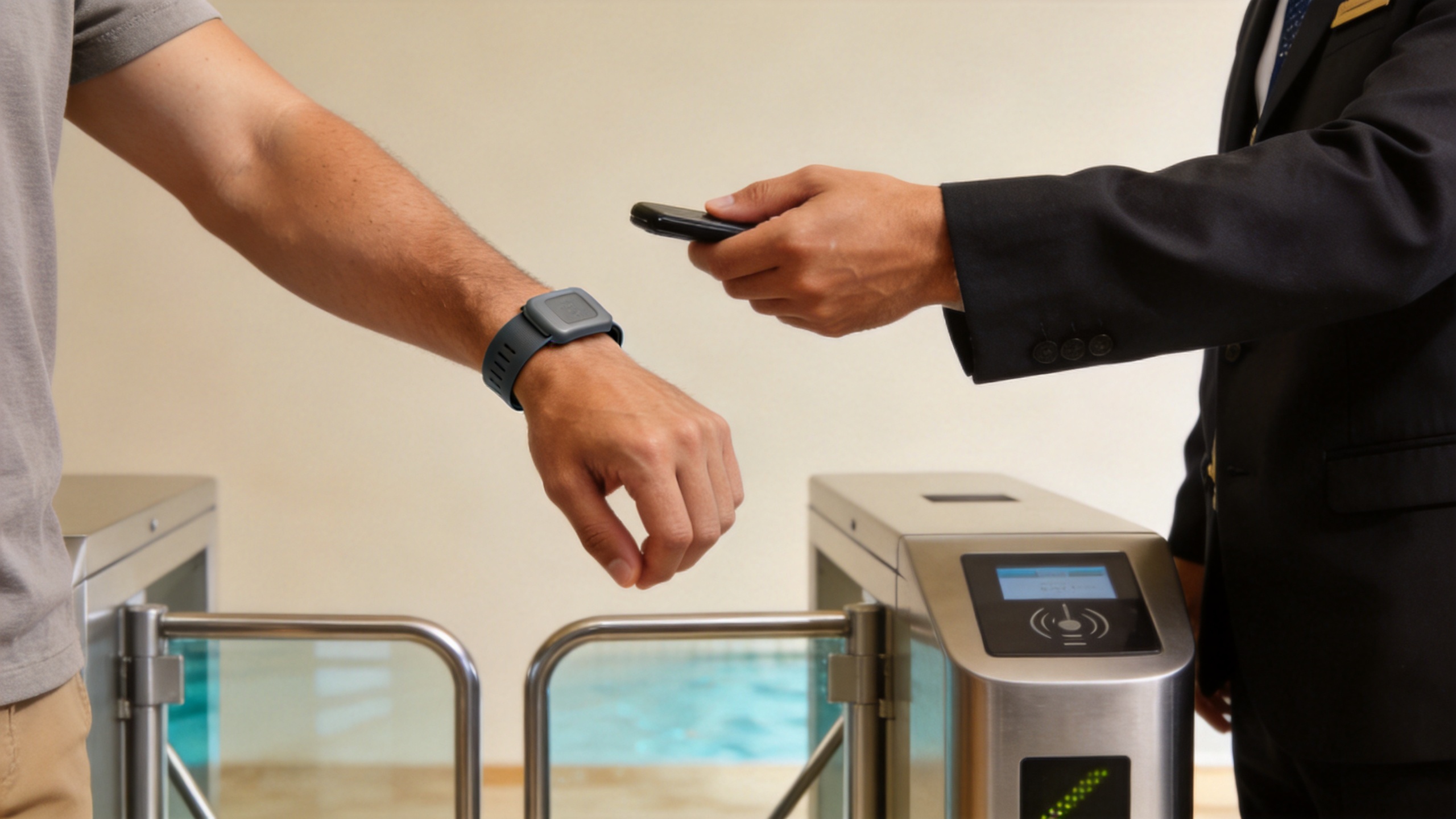
For example, a hotel may associate a wristband credential with a guest stay and set permissions for selected areas. A reader can then reject an unassigned or expired credential. Meanwhile, the intact closure gives staff a simple visual check when a guest enters an area without scanning or when an exception must be resolved. This combination is especially useful when a property wants hotel wristbands for access control to handle both attended and self-service entry points.
It is important not to overstate the role of the wristband. A band does not authenticate identity by itself, and an RFID chip does not prevent every form of credential sharing. The property still needs enrollment, deactivation, reader permissions, and a lost-band response process.
Build the control around the guest journey
An effective implementation starts at check-in rather than at the gate. Staff should explain where the wristband works, whether it must remain on for the duration of access, and what to do if it becomes uncomfortable or damaged. It can prevent disputes when a guest returns with a detached band.
- Issue: Assign the correct access profile and apply the band snugly but comfortably. Confirm any visible color, date, or zone indicator.
- Use: Let the reader or attendant enforce the relevant area rule. Keep staff instructions simple enough for peak periods.
- Exception: Treat a broken, cut, or questionable band as an exception, not an automatic admission. Verify eligibility before replacement.
- Replacement: Deactivate the old credential when possible, record the replacement, and use a process that limits repeat handoffs.
- Checkout or expiration: Remove access according to the end of stay, event, or booking period so the credential is no longer valid.
This workflow creates an audit-friendly separation between a guest who needs legitimate help and a band that may have been passed along. It also keeps front-desk, security, and amenity teams aligned on the same decision points.
Choose the wristband for the area, not just the artwork
Hotels often want bands to carry branding, but security should guide the final configuration. A high-turnover day-use pool may need a simple visual credential with a daily color change. A resort with several gated facilities may need a durable wearable credential linked to access permissions. A spa may need a discreet band that is comfortable in wet conditions and easy for attendants to inspect.
Before ordering, map each guest area to a rule: who may enter, when access ends, how entry is checked, and what staff do when the band is damaged. Then ask suppliers how the proposed closure behaves under normal use and attempted removal. Samples should be tested with the people who will issue and inspect them, not only by a purchasing team at a desk.
A practical checklist for reducing unauthorized access
- Use a closure that shows clear evidence of removal or attempted reuse.
- Match material and print method to water exposure, wear time, and inspection distance.
- Give each band a simple visual rule, such as a date, zone, or controlled color system.
- Connect electronic permissions to stay dates, reservations, or amenity eligibility where applicable.
- Train staff on the same broken-band and replacement procedure.
- Deactivate replaced, lost, and expired credentials promptly.
- Review incidents to find out whether the issue was the band, the reader configuration, or an unclear operating rule.
Deployment questions for tamper resistant hotel wristbands
When teams compare tamper resistant hotel wristbands, they should ask whether the closure makes transfer visible. When a property pilots tamper resistant hotel wristbands, it should test removal attempts, comfort, and the replacement process. For a resort team, tamper resistant hotel wristbands should be evaluated at the pool, spa, beach entrance, and any restricted lounge rather than only at a desk.
The same discipline applies to hotel wristbands for access control. Decide which guests receive hotel wristbands for access control, which locations recognize them, and when their permissions end. Staff who issue hotel wristbands for access control need a short script; staff who inspect hotel wristbands for access control need a consistent exception rule.
Ask these questions before rollout
- Can tamper resistant hotel wristbands be applied comfortably without leaving a reusable closure?
- Do tamper resistant hotel wristbands remain recognizable after the normal water and activity exposure of the selected amenity?
- Can a supervisor identify altered tamper resistant hotel wristbands quickly at the entry point?
- Does the replacement record disable an earlier credential when tamper resistant hotel wristbands are lost or damaged?
- Are hotel wristbands for access control configured by room type, reservation, time window, or area as the property intends?
- Will readers reject expired hotel wristbands for access control at every controlled entrance?
- Can attendants explain how hotel wristbands for access control work without disclosing unnecessary security details?
- Does the property review denied scans and altered bands to improve its hotel wristbands for access control process?
These questions turn tamper resistant hotel wristbands from a simple amenity marker into an accountable credential. They also ensure that hotel wristbands for access control support a documented guest-service process instead of creating inconsistent gate decisions.
The bottom line
Tamper resistant hotel wristbands are most valuable when they are part of a layered access process. Their purpose is straightforward: make transfer harder to hide, give employees a visible cue, and support the digital permissions behind a gate or service point. When the closure, credential configuration, and replacement policy are designed together, a hotel can make guest-area access easier to administer without turning every entrance into a confrontation.