EN
 AR
 CS
 DA
 NL
 FI
 FR
 DE
 EL
 HI
 IT
 JA
 KO
 NO
 PL
 PT
 RU
 ES
 SV
 ID
 SK
 SL
 ET
 TH
 TR
 MS
 KA
 UR
 BN
 MN

Key Balance Points When Selecting Low-Cost RFID Wrist Bands for Mass-Scale Events
Low cost RFID wrist bands are a sensible purchase only when they fit the actual gate workflow. In a mass event, the lowest unit quote can become the most expensive choice if a chip fails to read, a closure transfers easily, or the arrival schedule leaves no time for testing. A sound buying process compares usable bands at the gate, not price alone.
A procurement team should define reader requirements, wear conditions, access rules, encoding responsibility, and quantity reserve before comparing low cost RFID wrist bands. That turns a vague price discussion into a controlled specification.
1. Put Reader Compatibility Ahead of the Unit Quote
Low cost RFID wrist bands must match the installed reader frequency, chip family, and credential format. Ask the event-platform owner whether the system reads only a UID or needs protected memory, multiple permissions, locker access, or payment functions. RFID and NFC labels are not automatically interchangeable.
For basic admission, low cost RFID wrist bands with a standard identifier may meet the requirement well. Where the infrastructure expects a particular chip or data layout, a cheaper alternative that cannot be read is not a saving. Request a sample encoded with representative event data, and test it at an actual reader before bulk production.
This verification step matters especially when procurement, software, and venue operations are separate teams. Low cost RFID wrist bands should be approved by the person who can validate the live credential workflow, not only by the person reviewing artwork.
2. Match Material to the Event Environment
The right material depends on duration and exposure. For a short indoor program, low cost RFID wrist bands can use a simple secure construction if it remains intact for the visit. A multi-day outdoor event, however, may need more attention to wear, fit, print durability, and closure behavior.
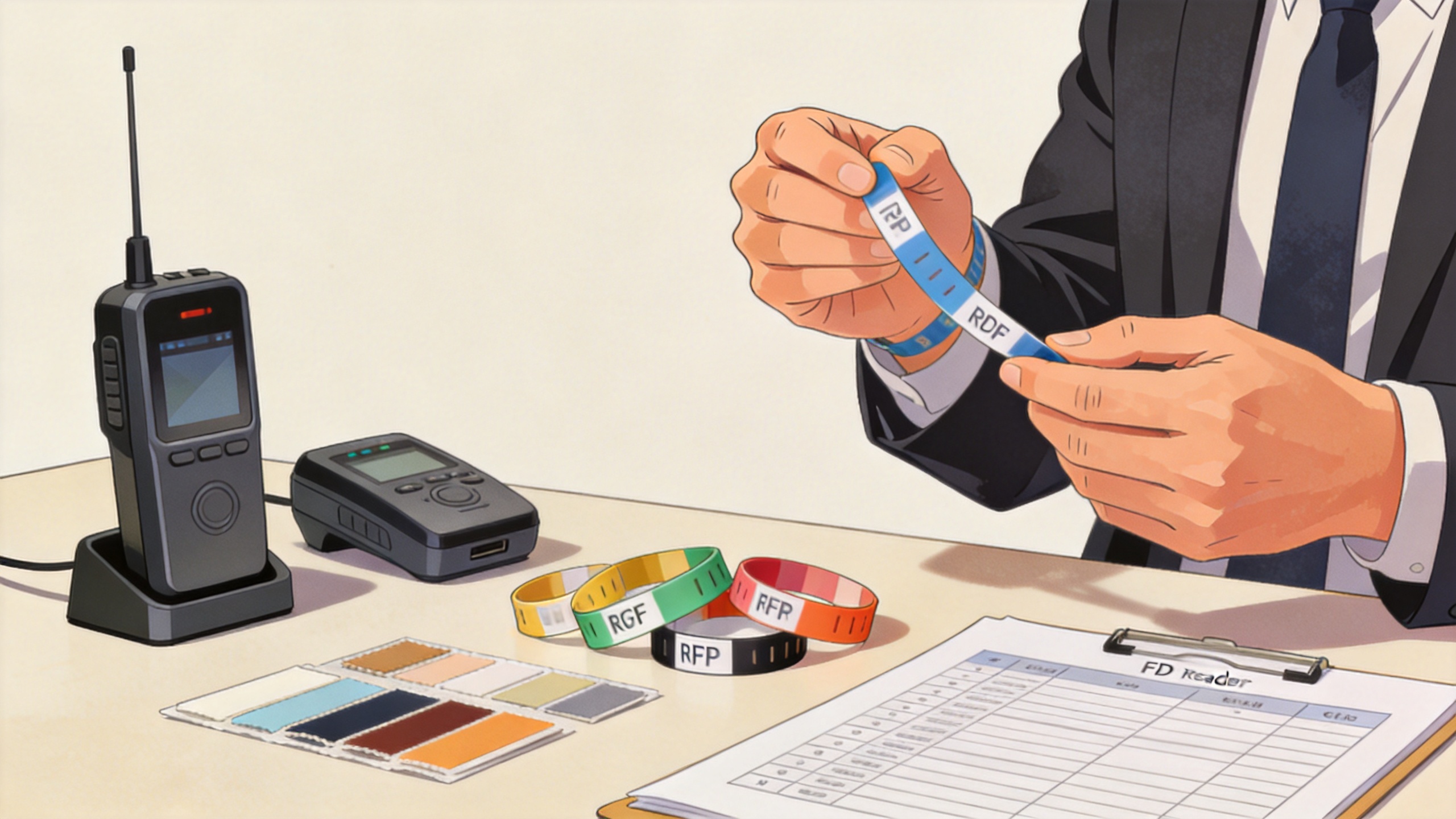
RFID wrist bands for water park operations need a distinct assessment. Water, sunscreen, chlorine, wet hands, and active movement change what “durable enough” means. Waterproof RFID wristbands are commonly used for water-park access control, yet the buyer should still confirm the material, closure, chip sealing, and intended wear period.
For low cost RFID wrist bands in wet venues, do not pay for a premium material by default; confirm the real exposure. A short swim-day visit and a multi-day resort program can justify different choices. The economical decision is the band that survives its expected use without adding unneeded features.
3. Treat the Closure as Part of Access Control
Low cost RFID wrist bands are physical credentials as well as electronic ones. A simple closure can be appropriate when transfer risk is low and staff also conduct visual checks. If re-entry, sharing, or credential accountability are concerns, specify the closure and replacement policy instead of assuming any clasp will deter transfer.
Ask three questions before choosing low cost RFID wrist bands: Can attendees leave and re-enter? How easily can one user pass a band to another? What does staff do when a band is damaged? The answers tell you whether a one-time closure, adjustable fit, color differentiation, or a different material has operational value.
4. Budget for Preparation and Recovery, Not Just Bands
The usable cost of low cost RFID wrist bands includes preparation. Include sample approval, data cleanup, encoding, read testing, sorting by access type, and distribution. When an event team has limited pre-event time, a correctly prepared order can be worth more than a small reduction in unit price.
Quantity planning also affects the value of low cost RFID wrist bands. Build the order from confirmed attendance, staff credentials, vendor credentials, and a defined operational reserve. The buffer should reflect the distribution method, event duration, and likelihood of replacements—not an arbitrary percentage copied from another event.
When personalization is required, low cost RFID wrist bands should have artwork, variable data, and access groups frozen early enough for a proof and a controlled test run. A last-minute file change can cost more than the feature it was intended to add.
5. Use This Decision Matrix
| Decision | Choose the lower-cost path when | Invest more when |
|---|---|---|
| Chip | Low cost RFID wrist bands only need standard UID entry. | The system needs protected data, multiple rights, or specialized integration. |
| Material | Low cost RFID wrist bands are used briefly in a dry, controlled setting. | Water, long wear, heat, or repeated activity is expected. |
| Closure | Low cost RFID wrist bands face low transfer risk and visible checks. | Re-entry control or stronger credential accountability is required. |
| Encoding | Low cost RFID wrist bands can be tested in-house with adequate time. | Data accuracy or pre-event time is limited. |
| Reserve | these RFID wristbands have predictable distribution and replacement demand. | Attendance, issue points, or exposure make replacements harder to forecast. |
6. Run a Bulk-Order Check Before Release
- For these RFID wristbands, confirm chip, frequency, and credential format with the system owner.
- For these RFID wristbands, document event duration, water exposure, and re-entry rules.
- For these RFID wristbands, define encoding ownership and test responsibility.
- For these RFID wristbands, specify material, fit range, closure, and artwork in writing.
- For these RFID wristbands, set the operational reserve before placing the full order.
- For these RFID wristbands, approve a sample and schedule an incoming inspection.
7. Make Low Cost a Controlled Choice
these RFID wristbands are most useful when they are selected for a defined job: compatible entry, appropriate wear resistance, clear issue rules, and a realistic preparation plan. Avoid buying complexity that the event is unlikely to use. Equally, do not remove a necessary requirement merely because its value is less visible on a quotation.
For standard indoor entry, these RFID wristbands may be the right answer. For aquatic use, complex permissions, or extended programs, compare the additional cost against recovery risk. That is how a volume buyer gets value from these RFID wristbands without turning a small unit-price saving into an event-day problem.