EN
EN
 AR
AR
 CS
CS
 DA
DA
 NL
NL
 FI
FI
 FR
FR
 DE
DE
 EL
EL
 HI
HI
 IT
IT
 JA
JA
 KO
KO
 NO
NO
 PL
PL
 PT
PT
 RU
RU
 ES
ES
 SV
SV
 ID
ID
 SK
SK
 SL
SL
 ET
ET
 TH
TH
 TR
TR
 MS
MS
 KA
KA
 UR
UR
 BN
BN
 MN
MN

How UHF Custom RFID Wristbands Improve Personnel Counting Efficiency at Venues
A venue count is only useful when the operations team can trust it. Manual clickers, visual estimates, and one-by-one scans can slow arrivals and make it hard to reconcile who is actually inside. UHF custom RFID wristbands give venues a way to identify entrants at a distance and turn read events into a more timely operational count—provided the system is planned as a counting workflow, not simply a wristband purchase.
From an RFID systems-engineering perspective, the important question is not “How far will a tag read?” It is whether readers, antennas, tag placement, gate geometry, and software rules can produce a count that staff can explain after a busy entry period. A wristband that reads inconsistently, or a dashboard that treats every repeated read as a new person, will not solve the problem.
Why venue counting becomes difficult at the gate
At a concert hall, stadium entrance, exhibition checkpoint, or staff-only zone, people do not arrive in perfectly spaced single file. Guests cluster, turn their bodies, carry phones and bags, and sometimes re-enter. That creates three practical challenges: capture every authorized person, avoid counting the same identifier repeatedly, and distinguish traffic direction where it matters.
Traditional visual counting adds labor at precisely the moment queues are most sensitive. A close-range credential check can validate access, but it also creates a serial process. UHF custom RFID wristbands support a different model: an EPC Gen2 UHF reader inventories tag identifiers in its configured read zone. The EPC Gen2 air-interface family operates in UHF bands subject to regional rules, and its anti-collision approach is designed for multi-tag inventory. That makes it relevant to throughput-focused venues, but it is not a blanket promise of a particular read rate or range.
How UHF wristbands turn reads into a usable personnel count
1. Each wristband carries a unique event identifier
A custom wristband can be encoded with a unique identifier tied to an attendee, worker, credential class, or issued inventory record. The identifier is the counting unit; the printed artwork is not. Before the event, define what one identifier represents and decide whether replacements, revocations, and staff credentials belong in the same count or in separate groups.
This is also why compatibility comes before design. Confirm that the wristband chip protocol, reader hardware, middleware, and event platform use the same identifier format. Selecting on unit price before checking the installed reader infrastructure is a common source of avoidable rework.
2. Readers observe a controlled passage zone
The practical gain comes from shaping a read zone around a passage, not from trying to read every wristband across an open concourse. Antenna position, power settings, lane width, shielding, nearby metal, and the way guests wear the band all affect the result. For an indoor gate with predictable lanes, a narrowly tested zone may be easier to reconcile than a high-power setup that sees tags from adjacent queues.
Start with the actual operating condition. If the entrance is outdoors, crowded, or shared with a nearby credential desk, test it in that condition. A configuration that looks clean with a few wristbands on a table may behave differently when people move through in groups.
3. Software applies event rules to repeated tag reads
A reader can observe the same wristband more than once. Counting efficiency therefore depends on rules such as a de-duplication window, an “entered” state, an “exited” state, and an exception queue for unclear direction. With those rules in place, multiple reads of one identifier become confirmation rather than multiple admissions.
For example, a venue may count a credential once when it first crosses an inbound gate, retain later reads as audit evidence, and flag another inbound event only after a defined exit or re-entry condition. This produces a defensible attendance total instead of a raw-read total.
Why UHF custom RFID wristbands improve the counting process
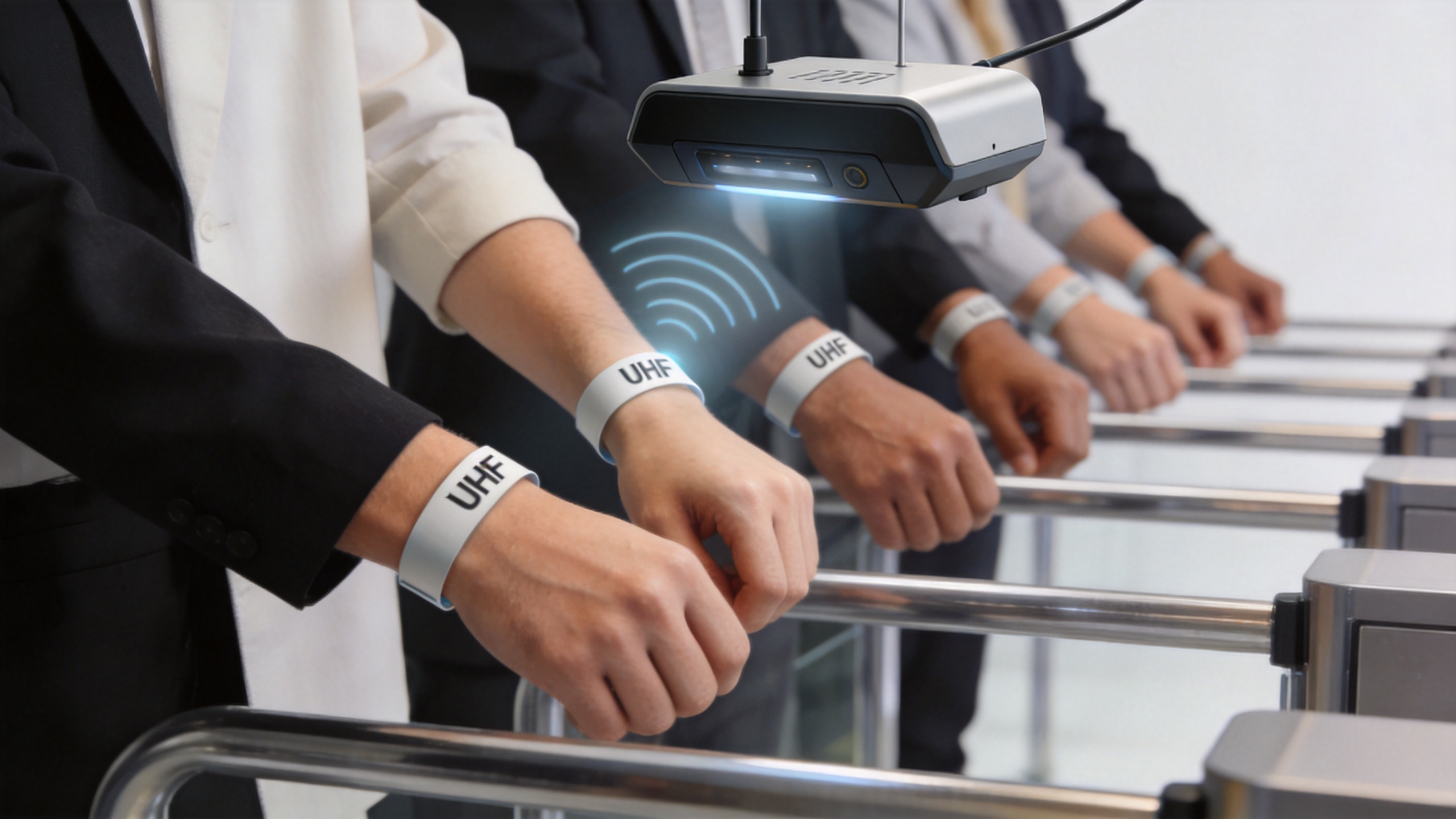
For a high-throughput entrance, UHF custom RFID wristbands can let the reader inventory identifiers as people pass through a defined zone instead of asking staff to search for and scan every credential one at a time. That changes the staff task from repetitive counting to supervising exceptions, protecting lane discipline, and reconciling unusual events.
The benefit remains conditional. UHF custom RFID wristbands should be validated with the reader settings, local frequency rules, and gate layout that the venue will actually use. A pilot should deliberately test close spacing, turns, re-entry, and people waiting alongside the lane. These tests help the team decide whether the system needs a narrower zone, different antenna placement, clearer queue barriers, or a different workflow.
For procurement, an rfid wrist bands bulk order should include spare credentials and an issuance log, not just a final quantity. When an attendee receives a replacement, the old identifier needs a defined status; otherwise a count that appears to be a reader problem may be an administration problem.
Where customisation helps the deployment
- Visual segmentation: printed colours, dates, zones, or staff labels help personnel spot the correct credential class without replacing the electronic identifier.
- Encoding preparation: pre-encoding a consistent identifier structure can reduce the on-site task of issuing and checking large batches.
- Material and closure choices: choose a band that remains comfortable and attached for the event duration. A multi-day outdoor event needs different validation than a short indoor session.
- Allocation controls: sequential or recorded issuance makes it easier to investigate missing bands, replacements, and unused stock.
When planning an rfid wrist bands bulk order, ask the supplier for a sample batch that represents the final material, chip, print process, and encoding method. Treat it as a systems test artifact. It is more useful to discover a reader or placement issue before thousands of credentials are distributed.
A practical counting workflow for venue teams
- Define the count: decide whether the dashboard reports admissions, unique people currently inside, staff on site, or occupancy by zone.
- Map the physical journey: identify entrances, exits, bypass routes, staff doors, and places where people may pause near a reader.
- Assign unique IDs: document the encoding convention and make sure the event platform can recognize it.
- Run a live-path test: test individual, paired, and closely spaced movements with the actual wristband orientation expected at the venue.
- Set reconciliation rules: compare reader events with issued-band records, manual exception logs, and known gate incidents rather than assuming every dashboard number is final.
- Brief the gate team: staff should know what an exception looks like and how to resolve it without creating an uncontrolled queue.
What UHF wristbands do not solve by themselves
UHF custom RFID wristbands can reduce manual counting steps, but they do not automatically establish capacity compliance, identity verification, or anti-passback policy. Those outcomes depend on the software configuration and operating procedure. Likewise, a UHF deployment may not be appropriate where the installed system was designed for a different frequency or a close-tap interaction.
The right approach is conditional: if a venue needs to observe high-throughput movement through a controlled read zone, UHF can be a strong fit. If the priority is deliberate one-person confirmation at a small checkpoint, another credential workflow may be more suitable. The design should follow the counting decision, not the other way around.
Choosing a supplier for a bulk deployment
For an rfid wrist bands bulk order, give the supplier a concise deployment brief: country or region, reader model and protocol, event duration, wristband material preference, identifier format, artwork requirements, quantity, and a sample-test deadline. Ask which details need technical confirmation instead of accepting generic range claims.
Chengdu Mind IOT Technology supplies RFID, NFC, and UHF wristband options for event access and tracking applications. A productive supplier discussion starts with compatibility and encoding requirements, then moves to custom printing and production planning. That order helps prevent a visually suitable wristband from becoming an operational mismatch.
Make the count explainable, not merely fast
A meaningful result from UHF custom RFID wristbands is not just a quicker gate. It is a personnel-counting process with a known identifier, a tested read zone, clear duplicate handling, and an exception trail. Build those controls into the pre-event plan, test with real movement, and use the resulting data to support operations decisions throughout the venue.