EN
EN
 AR
AR
 CS
CS
 DA
DA
 NL
NL
 FI
FI
 FR
FR
 DE
DE
 EL
EL
 HI
HI
 IT
IT
 JA
JA
 KO
KO
 NO
NO
 PL
PL
 PT
PT
 RU
RU
 ES
ES
 SV
SV
 ID
ID
 SK
SK
 SL
SL
 ET
ET
 TH
TH
 TR
TR
 MS
MS
 KA
KA
 UR
UR
 BN
BN
 MN
MN

Can RFID Wristbands Made from Natural Materials Offer the Same Durability?
Buyers often ask whether an eco friendly programmable rfid bracelet can replace a conventional plastic wristband without becoming the weak point at the gate. The honest answer is: sometimes, but not under every operating condition. A natural-material band can provide dependable access identification when its substrate, closure, RFID inlay protection, and event conditions are designed as one system.
As an RFID solutions engineer, I start with the technical constraint rather than the appearance. The eco friendly programmable rfid bracelet must keep the chip readable, attached to the wearer, and compatible with the installed reader for the full use period. A bamboo, cotton, wood, or paper-based component does not automatically make the RFID function less durable; the failure point may instead be the closure, laminate edge, antenna bond, or exposure to water.
What “the same durability” should mean
Durability is not a single material score. For an eco friendly programmable rfid bracelet, it means the wristband survives the actual event journey: shipping, issue at registration, friction against clothing, sweat or rain, scanning, and removal. A one-day indoor conference needs a different answer than a three-day outdoor festival or a water-park deployment.
- Wear durability: the band resists tearing, fraying, stretching, and accidental release.
- RF performance durability: the inlay and antenna continue to communicate with the reader.
- Closure durability: the fastener remains secure enough for the chosen anti-transfer policy.
- Finish durability: printing, numbering, and branding remain legible through use.
This distinction matters for every eco friendly programmable rfid bracelet. A soft textile may feel robust while its exposed chip module needs extra protection. Conversely, a rigid wood tag can protect the chip but needs a fabric or cord connection that will not pull apart.
Natural materials and their real trade-offs
Bamboo and cotton fabrics
Woven natural fabrics are comfortable and visually appropriate for credentials, hospitality, and multi-day events. They can make an eco friendly programmable rfid bracelet feel more like a reusable accessory than a disposable pass. Their key limitation is moisture management. Fabric can absorb water and soil, so the RFID inlay normally needs a protected sewn, bonded, or encapsulated zone. Ask for samples after the same washing, sweat, or rain exposure expected at the venue.
Wood or plant-based tag components
A wood token or plant-based composite can give an eco friendly programmable rfid bracelet a premium, low-plastic presentation. It is often suitable as the carrier around a protected RFID or NFC inlay, not as the only protective layer. Edge finish, hole reinforcement, and the join to the wrist strap deserve as much review as the tag face.
Paper-based and seed-paper options
Paper-derived bands are most credible for short, dry, controlled use. They can support an eco friendly programmable rfid bracelet for a brief registration flow, but they are usually a poor choice where immersion, heavy perspiration, repeated abrasion, or aggressive anti-transfer enforcement is expected. Do not let a sustainability claim hide an unsuitable duty cycle.
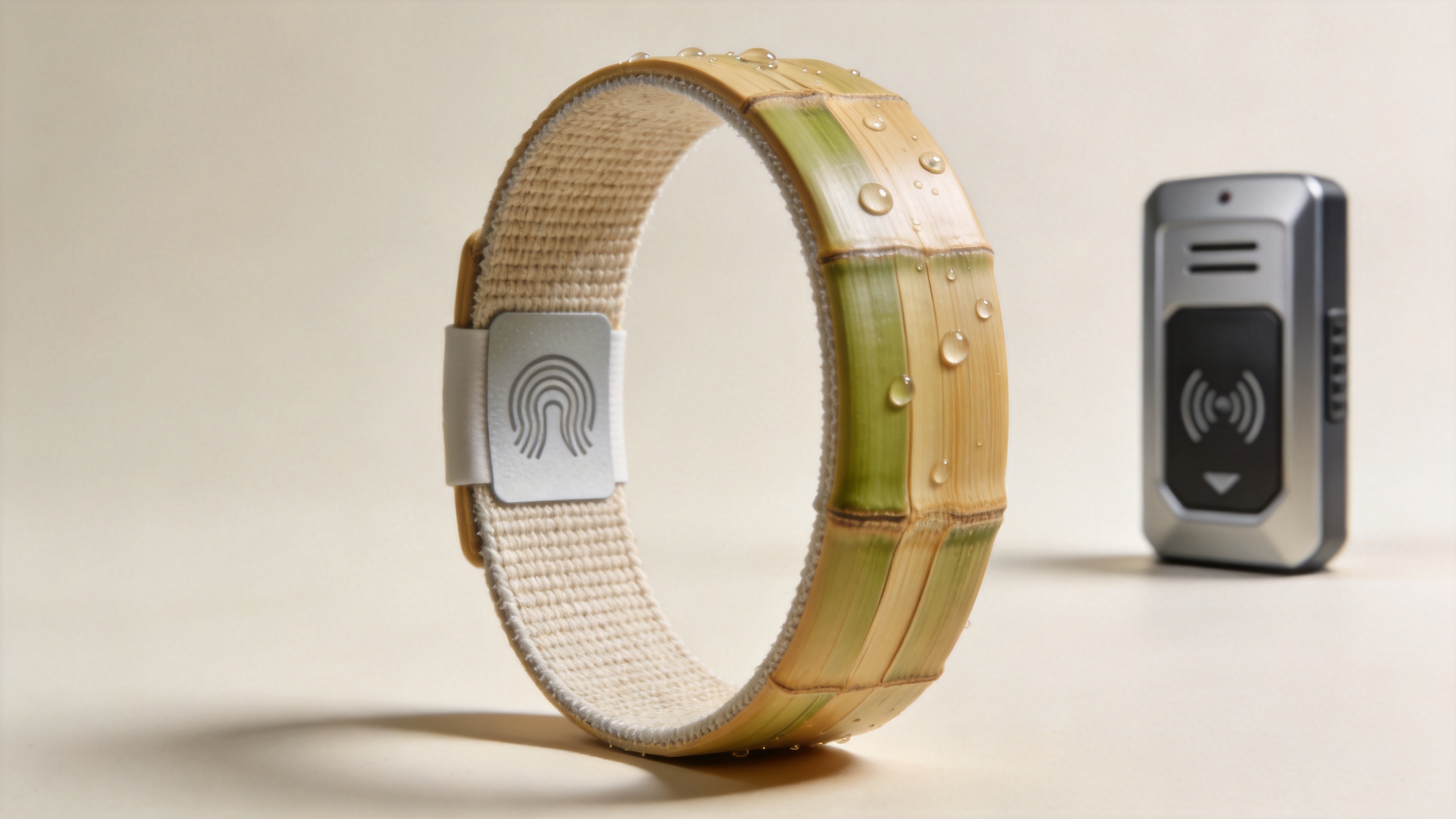
The RFID inlay is a separate durability decision
The phrase eco friendly programmable rfid bracelet combines two choices: the wearable material and the electronics. Keep them separate during specification. The chip family and frequency must match the existing access, payment, or attendance infrastructure. I spent weeks comparing RFID and NFC wristbands before someone pointed out that the existing gate reader infrastructure already determined which protocol was practical. That is still the fastest way to avoid a beautiful but unusable order.
Then protect the inlay for its location. A protected module, a sealed antenna area, and strain relief around bends can matter more than whether the visible strap is natural fiber. The short answer is that a natural band can be durable—actually, let me qualify that: it can be durable enough when the inlay package and attachment method are selected for the exposure, not merely for the sales sample.
How to compare a natural-material band with PVC or silicone
| Decision factor | Natural-material approach | PVC or silicone reference point |
|---|---|---|
| Dry indoor use | Fabric, wood, and carefully finished paper options can be practical. | Generally tolerant and familiar. |
| Rain, pools, or heavy sweat | Needs protected inlay, moisture-aware closure, and sample testing. | Often easier to manage, but still needs an appropriate chip package. |
| Multi-day wear | Textile can be comfortable; inspect fray resistance and clasp security. | Often robust, though comfort and sustainability goals differ. |
| Reuse | Choose washable or serviceable components only when the inlay and closure support it. | May be simpler operationally; confirm cleaning compatibility. |
That comparison is not an argument that one material wins in every case. An eco friendly programmable rfid bracelet is the better choice when the event benefit of a lower-impact or more tactile credential aligns with the exposure profile. For wet, highly abrasive, or long-term reuse cases, a conventional protected band may remain the safer operational baseline.
A practical test plan before ordering
- Define the duty cycle. Record event length, outdoor exposure, water contact, expected scan count, and whether attendees may transfer the band.
- Confirm reader compatibility. Validate the selected chip and encoding method with the deployed readers before approving material production.
- Test representative samples. Wear, bend, scan, and pull-test samples after simulated handling. Test the closure and inlay zone, not just the printed strap.
- Set acceptance criteria. Agree on readable scans, intact closures, legible artwork, and permitted cosmetic changes after the test.
- Plan end of use. State which parts are reusable, recoverable, recyclable, or subject to local disposal rules.
This process turns an eco friendly programmable rfid bracelet from a marketing concept into a controlled procurement decision. It also keeps the supplier conversation focused on observable conditions rather than a broad promise of “durable.”
Questions to ask a supplier
- Which part of the eco friendly programmable rfid bracelet contains the RFID inlay, and how is it protected from bending and moisture?
- What event duration and environment was the selected material designed for?
- Can the closure be configured for single-use, adjustable, or reusable wear?
- Which reader protocol and encoding workflow are supported by the chip option?
- Can pre-production samples be tested with our readers and event conditions?
Bottom line
Natural materials can offer comparable functional durability for the right use case, but only when the full construction is specified. The most reliable eco friendly programmable rfid bracelet is not necessarily the one with the most natural-looking surface; it is the one whose substrate, closure, inlay protection, and reader compatibility match the event. If your priority is a dry, short-to-multi-day event with a tactile sustainable credential, evaluate fabric or wood-based options with protected electronics. If your constraint is frequent water exposure or severe abrasion, prioritize environmental protection first and treat natural materials as a carefully tested design layer.