EN
 AR
 CS
 DA
 NL
 FI
 FR
 DE
 EL
 HI
 IT
 JA
 KO
 NO
 PL
 PT
 RU
 ES
 SV
 ID
 SK
 SL
 ET
 TH
 TR
 MS
 KA
 UR
 BN
 MN

Top Cost-Saving Advantages Reusable Hotel Wristbands Bring for Hotel Businesses
For a hotel, a wristband is not merely a guest identifier. It can be a recurring operating expense, a check-in task, a lost-property issue, and—when it works with the property’s access setup—a simple way to manage room and amenity access. Reusable hotel wristbands change the calculation because the purchase decision can be assessed over multiple guest stays rather than as a one-time consumable order.
From an event-operations perspective, the useful question is not “Are reusable bands cheaper per unit?” A durable band may cost more initially. The better question is whether reusable hotel wristbands reduce the total work and replacement spending associated with access credentials at a particular property. That depends on return rates, inspection, cleaning, programming, compatibility, and the mix of guests who use them.
1. They can spread procurement cost across more than one stay
The most direct financial advantage of reusable hotel wristbands is the opportunity to use an item more than once. A single-use band is normally an expense attached to one guest, day pass, or event. A reusable model can remain in circulation after checkout if the hotel has a reliable process to collect, inspect, clean, store, and reissue it.
This does not make every band a saving. A band that is not returned, is damaged, or cannot be safely reissued still needs replacement. However, a hotel can compare choices with a simple lifecycle model: total band spend plus replacement spend plus labor for issuing, recovery, inspection, cleaning, and encoding. Divide that figure by the number of successful guest uses. That calculation is more useful than comparing purchase prices alone.
2. They may cut avoidable replacement purchases
Hotels often replace credentials because they are discarded at checkout, damaged near pools or beaches, or separated from their original guest record. Reusable hotel wristbands make a return-and-reissue workflow possible, so a band in acceptable condition does not automatically become waste after one stay. The potential saving comes from reducing unnecessary replenishment orders, not from assuming that every band will last forever.
For a resort with wet-area access, material selection matters. Comfort, water resistance, closure design, and the expected duration of wear should be considered together. If a property’s typical guest journey includes a room, pool, gym, spa, or private-area credential, the band needs to suit the real environment—not just look suitable in a sample pack.
3. They can consolidate guest access tasks
When compatible with the existing reader and credential system, reusable hotel wristbands can support a simpler access routine. Instead of issuing separate items for several approved areas, a hotel may use one encoded credential for the permissions it chooses to grant. Search results for hotel RFID bands commonly describe uses such as room, pool, beach, gym, spa, and VIP-area access.
The operational value is in reducing handoffs and exceptions. Front-desk employees have fewer physical items to explain; attendants can verify access through the established process; and guests are less likely to carry a separate card while swimming or exercising. Compatibility must be confirmed before any savings case is approved. A hotel wristbands manufacturer should be able to discuss the relevant frequency, chip option, encoding workflow, form factor, and reader-system constraints instead of treating all RFID bands as interchangeable.
4. They give hotels a clearer recovery and loss-control process
A reusable system only saves money when recovery is designed into operations. With reusable hotel wristbands, hotels can explain the return expectation at check-in, include it in the checkout routine, use a clearly marked collection point, and designate someone to sort returned bands. Those small controls help the property measure its real recovery rate rather than relying on an assumption.
The same discipline supports security. A returned band should be checked before reissue, and access permissions should be managed through the hotel’s normal credential process. A hotel should not assume that reusability removes the need for deactivation, identity checks, or procedures for a lost band. Good controls protect both the savings model and guest access.
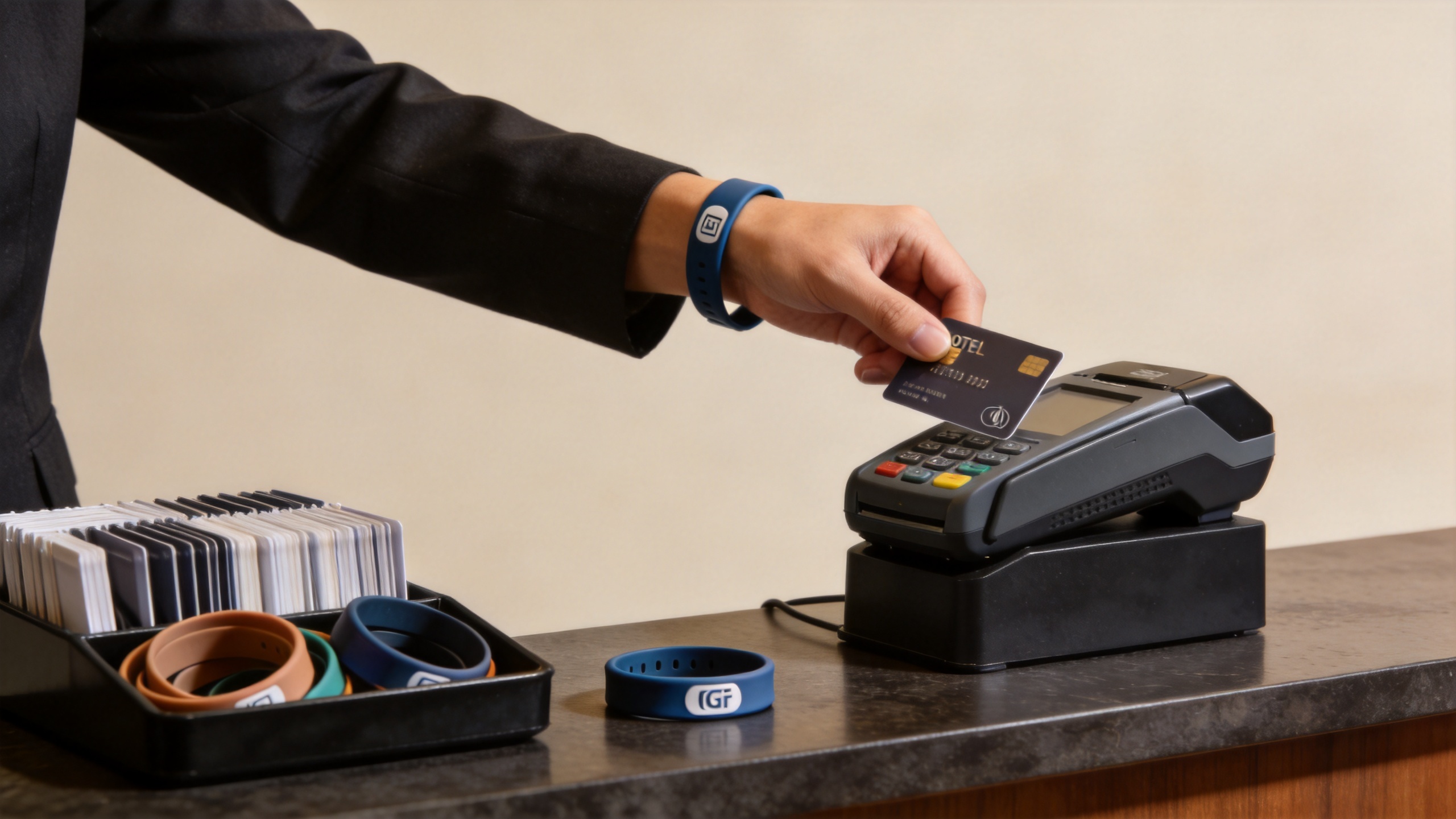
5. They can make inventory planning less reactive
Disposable credentials often lead teams to reorder based on an approaching event, seasonal occupancy, or a nearly empty drawer. With reusable hotel wristbands, inventory can be planned around an operating pool: bands in service, bands awaiting inspection, approved reissue stock, damaged units, and contingency stock. That visibility can make purchasing less urgent and reduce the chance of paying for avoidable rush orders.
It also gives procurement a better way to compare options. Track how many bands are issued, returned, rejected, reprogrammed, and replaced each month. After several cycles, the hotel can see whether a particular material and operating procedure actually supports the expected reuse level. The result is a more defensible purchasing decision than a generic “reusable equals cheaper” claim.
6. They support a more durable guest-facing credential
Guests judge access tools by convenience as much as by technology. Reusable hotel wristbands can be easier to keep on hand during a pool visit, beach day, workout, or family activity than a card that must be carried separately. When a credential fits the guest journey, staff may spend less time handling preventable “I left my card behind” questions or replacing wet and worn items.
That said, comfort and fit are practical cost issues too. An uncomfortable wristband may be removed; a loose one may be lost; a closure that does not match the use case may create complaints. Ask for samples and test them in the conditions that matter to the property before building a business case around reuse.
A practical way to evaluate the savings case
Before ordering reusable hotel wristbands, build a small pilot around a defined guest group or amenity. Record the initial credential cost, labor time at issue and return, recovery rate, cleaning and inspection steps, damaged-band rate, replacement rate, and any reader or encoding work. Then compare the cost per successful use with the property’s current method.
- Confirm technical compatibility with existing locks, readers, and encoding procedures.
- Set a clear return, deactivation, inspection, and reissue workflow.
- Choose a material based on actual water exposure, wear time, and guest comfort needs.
- Measure recovery and rejection rates before committing to a larger operating pool.
- Request practical technical guidance from a hotel wristbands manufacturer, including chip and encoding options relevant to the property system.
Reusable hotel wristbands are most valuable when the physical band, access technology, and hotel workflow work together. For a property that can recover and reissue bands consistently, they can reduce recurring credential waste, support steadier inventory planning, and simplify access handling. For a property without those controls, the expected savings may not materialize. The sensible approach is to test the full lifecycle, then scale what the data supports.