EN
EN
 AR
AR
 CS
CS
 DA
DA
 NL
NL
 FI
FI
 FR
FR
 DE
DE
 EL
EL
 HI
HI
 IT
IT
 JA
JA
 KO
KO
 NO
NO
 PL
PL
 PT
PT
 RU
RU
 ES
ES
 SV
SV
 ID
ID
 SK
SK
 SL
SL
 ET
ET
 TH
TH
 TR
TR
 MS
MS
 KA
KA
 UR
UR
 BN
BN
 MN
MN

How RFID Hotel Wristband Simplify Guest Access and In-Hotel Consumption Procedure
At a busy resort, the friction is rarely the door itself. It is the chain of small interruptions around it: a guest looking for a key card after the pool, a cashier checking a room number, or a receptionist untangling a lost-card request. An rfid band for hotel can replace several of those handoffs with one credential worn on the wrist. The useful question is not whether the band can scan; it is how the hotel connects that scan to a controlled guest-access and spending procedure.
From an operations perspective, the wristband should behave like a temporary, permission-based guest token. Its identifier must be associated with the right reservation, access rules, payment permissions, and expiry time. That design lets a hotel simplify the guest journey without treating every scan as an automatic approval.
What an RFID hotel wristband actually does
An rfid band for hotel contains a chip and antenna that a compatible reader can identify at close range. The reader may sit at a room lock, pool gate, spa entrance, POS terminal, or staff checkpoint. The chip does not have to hold a guest’s full personal profile. In a well-designed workflow, it presents an identifier; the connected hotel system determines what that identifier is currently allowed to do.
That distinction matters. A wristband that opens a room but cannot be recognized by the hotel’s point-of-sale environment is only a room key. A wristband connected to the property-management system (PMS), lock system, and POS can support a wider guest flow: check in once, enter permitted areas, charge eligible purchases, then have the credential expire at checkout.
Compatibility is the first technical checkpoint. Many hotel systems use 13.56 MHz credentials and ISO/IEC 14443-family technologies, but operators should confirm the exact credential type, reader configuration, encoding method, and software interface with their own lock and PMS providers. “RFID compatible” on its own is not a sufficient purchasing specification.
The guest procedure: from check-in to checkout
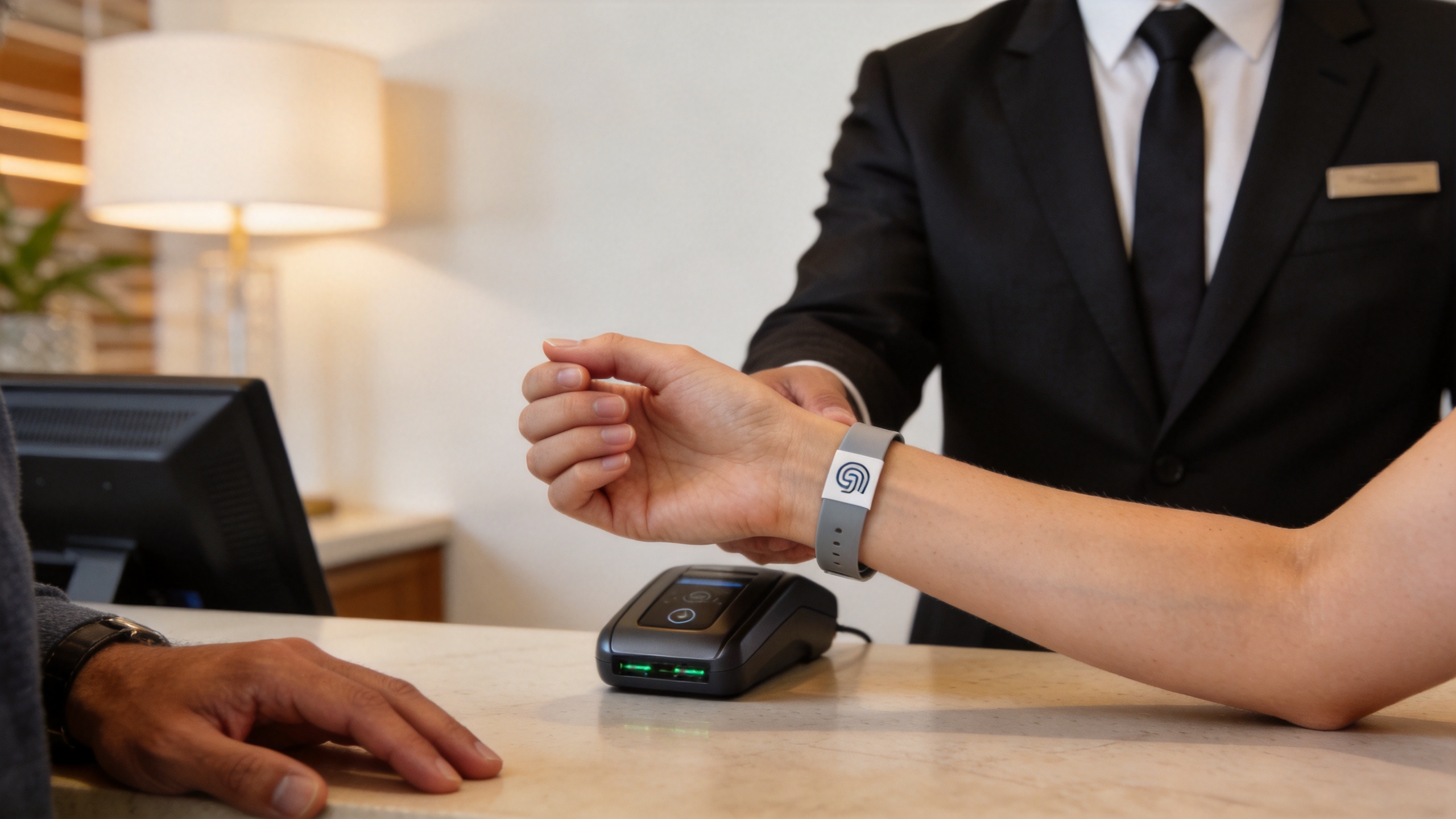
1. Issue and associate the band at check-in
At arrival, staff register the rfid band for hotel against the reservation or guest account. The system should apply a start time, planned checkout or expiry time, room-access rights, and the amenities included in the booking. If a family receives several bands, each band should be individually traceable while sharing only the permissions the hotel intends to share.
This is also the point to set consumption rules. A hotel may allow room charging, require a PIN for higher-value transactions, set a per-band or per-room limit, or disable charging for a child band. The policy is a management decision; the wristband simply carries the identifier that invokes it.
2. Validate access at doors and amenities
When the guest presents the band to a reader, the reader checks whether the identifier is active and whether that guest is entitled to enter at that time. For a room lock, the rule may be limited to the assigned room and stay dates. For a pool, spa, lounge, beach gate, or gym, the rule may depend on the booking package, appointment, age policy, or opening hours.
This is where reusable hotel wristbands are particularly practical in wet or active settings. A guest does not need to carry a paper slip or a key card around a pool. Still, the material, closure, chip placement, cleaning method, and wear period need validation for the specific property. A band intended for a short indoor stay may not be the right choice for a multi-day water-oriented resort program.
3. Route consumption through the POS approval flow
At a restaurant, bar, gift shop, or activity desk, the cashier scans the rfid band for hotel and the POS retrieves the eligible guest account or wallet. Before the sale is confirmed, the system should show enough information for the attendant to verify the transaction: guest or account reference, authorization status, applicable limit, and any required signature or PIN rule.
The consumption procedure should not rely on the band alone. A robust flow records the venue, terminal, time, amount, operator, and transaction result. If the guest is using post-to-room charging, the PMS or linked account receives the charge. If the hotel uses a prepaid resort wallet, the POS should receive an approval or decline based on the current balance and policy.
4. Handle exceptions immediately
Lost-band handling is where the value of a centralized procedure becomes obvious. Staff should be able to deactivate the old identifier immediately, verify the guest using the property’s normal identity process, and issue a replacement with the required permissions. The old band must not remain active until the next system sync or until the guest reports it at checkout.
Other exceptions deserve a clear playbook as well: a reader is offline, a band is damaged, the POS cannot reach the guest account, or a guest disputes a charge. Staff need a controlled fallback, such as a verified manual lookup and supervisor approval, rather than an informal bypass that creates untraceable access or spending.
5. Close the credential at checkout
At checkout, the hotel settles outstanding charges and deactivates the rfid band for hotel. For reusable hotel wristbands, staff can collect the band, inspect it, clean it according to the material supplier’s instructions, and return it to a controlled inventory process. If collection is impractical, automatic expiry is still essential. A band should not retain room or amenity access after the authorized stay.
Why the procedure is more important than the wristband itself
A hotel can gain convenience from an RFID credential, but the operational benefit comes from consistent rules across systems. A practical deployment maps each guest touchpoint before ordering bands:
- Identity and enrollment: Which system creates the credential, and who may issue it?
- Access: Which doors, gates, and amenities read it, and how are time-based permissions enforced?
- Consumption: Is spending posted to a room, deducted from a prepaid balance, or prohibited for certain bands?
- Security: What happens to a lost band, an attempted duplicate, or an offline reader?
- Reconciliation: Can finance and operations trace each transaction and investigate exceptions?
- End of stay: How do deactivation, band recovery, cleaning, and reuse work?
That mapping often reveals integration gaps early. For example, the lock provider may support a particular chip format while the POS vendor expects a different account lookup. It is better to discover that during a pilot than after bands have been encoded and distributed.
A rollout checklist for hotel teams
- Document the existing PMS, lock, POS, access-control, and payment workflow.
- Confirm credential protocol, reader compatibility, encoding ownership, and API or middleware requirements with each vendor.
- Define guest groups, amenity entitlements, spending limits, approval rules, and expiry behavior.
- Test room entry, re-entry, pool or spa access, dining charges, refunds, lost-band replacement, and checkout with real front-desk and outlet staff.
- Train staff on the exception path, including identity verification and immediate deactivation.
- Measure failed reads, manual overrides, disputed transactions, and band recovery during the pilot before expanding property-wide.
Final takeaway
An rfid band for hotel can make access and in-hotel spending feel simpler for guests because one credential replaces multiple cards, tickets, and account lookups. For the hotel, however, the result depends on careful system compatibility, defined permissions, transaction controls, and a fast exception process. Start with the guest journey, test the operational handoffs, and choose reusable hotel wristbands only after the chip, material, and lifecycle fit the property’s actual environment.