EN
 AR
 CS
 DA
 NL
 FI
 FR
 DE
 EL
 HI
 IT
 JA
 KO
 NO
 PL
 PT
 RU
 ES
 SV
 ID
 SK
 SL
 ET
 TH
 TR
 MS
 KA
 UR
 BN
 MN

How NFC Wristbands for Events With QR Code Enrich Multi-Dimensional Participant Identification
At a busy event entrance, identifying a person is not the same as confirming that person may enter. The first question is usually simple: who is presenting this credential? The next questions are operational: is it valid now, which zone is allowed, has it been revoked, and what should happen if the preferred reader is unavailable? NFC wristbands for events with QR code can support this layered decision when the event platform treats the wristband as a pointer to a controlled participant record rather than as the record itself.
From an access-control design perspective, the useful idea is not that NFC and QR are interchangeable. They give staff two different ways to locate or verify a credential. NFC is a proximity interaction; the printed QR code is a visible, camera-readable fallback. Used together, they can make a participant journey more resilient without giving every scanner the same level of authority.
Start with a multi-dimensional participant model
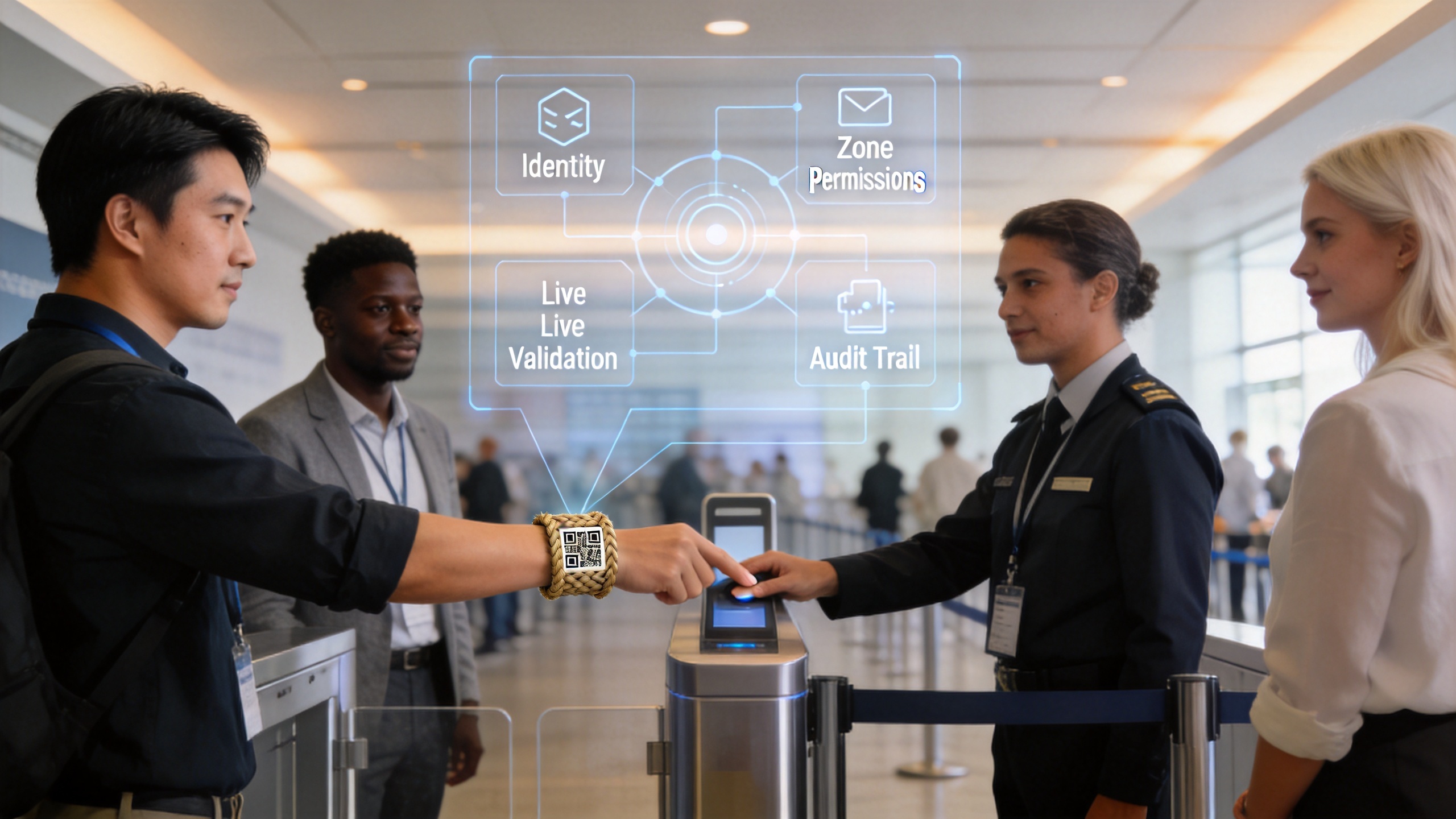
A wristband should not be asked to carry every fact about a participant. Instead, create a server-side profile that links several dimensions to one credential reference:
- Identity: attendee, staff member, speaker, exhibitor, contractor, or guest.
- Entitlements: permitted entrances, session rooms, meal periods, transport, or restricted work areas.
- State: issued, active, suspended, replaced, checked in, or expired.
- Context: event day, venue, zone, gate, and the staff device that performed the check.
- Audit trail: timestamped attempts and the allow or deny decision.
That model makes NFC wristbands for events with QR code more than a printed ticket. A gate can use an NFC tap to retrieve a short credential reference, while a help desk can scan the QR code to locate the same registration during a device outage or an exception review. The server decides whether the participant is allowed; the physical mark merely helps find the right record.
Give NFC and QR code different operational jobs
NFC Data Exchange Format (NDEF) provides a standardized structure for NFC application data. In an event deployment, that does not mean putting names, permissions, or payment details directly onto a tag. A conservative pattern is to encode a limited identifier or a controlled URL that resolves through the event system. The event platform then checks current permissions and state before it returns an outcome.
The QR code can point to the same participant record, a short-lived verification endpoint, or a separately scoped fallback credential. Its value is practical: a camera-equipped phone can read it, and it remains visible when an attendee does not know how to tap a wristband. Its limitation is equally practical: a static code can be photographed or forwarded. For that reason, a scan should lead to a fresh authorization decision rather than be treated as proof by itself.
| Layer | NFC interaction | QR interaction | Control to keep server-side |
|---|---|---|---|
| Arrival check-in | Fast tap at staffed entry | Camera scan for exceptions | Registration state and duplicate-check logic |
| Zone access | Reader validates a credential reference | Staff verifies a fallback reference | Time, zone, role, and revocation rules |
| Session attendance | Tap captures attendance with low friction | Scan supports temporary stations | Session capacity and audit record |
| Support desk | Tap locates the account | Printed code supports visual troubleshooting | Replacement and identity-check workflow |
Design the verification flow before selecting the band
The most common deployment problem is not the chip; it is an unfinished decision flow. Before ordering, map each checkpoint with four questions: which reader is available, which identity reference it reads, what service validates the reference, and what staff do when validation fails. A reader-density mistake can create queues even when the wristband itself works perfectly. Likewise, a QR fallback is only useful when staff know which screen shows a valid result and which result requires escalation.
For woven nfc wristbands for events, include the physical workflow in that map. Confirm where the antenna area sits, how the adjustable clasp affects presentation to a reader, and whether the printed QR remains legible after multi-day wear. A small on-site scan-angle test is worth doing: different phones, reader housings, and wrist positions can change the speed of a real check.
Protect against sharing, loss, and replacement
No wristband format eliminates fraud on its own. The practical goal is to make unauthorized use easier to detect and safer to resolve. Do not rely on a printed code as the only credential for a high-value area. Do not assume an NFC identifier is a secret merely because it is not visible. Pair the identifier with server-side state, role-based rules, event-day validity windows, and a clear replacement process.
When a participant reports a lost band, staff should be able to suspend the original credential, issue a replacement reference, and record the reason. At the next gate, the old band should produce a clear deny response while the new one follows normal flow. That is the operational advantage of treating NFC wristbands for events with QR code as connected credentials instead of one-time printed tokens.
Build for graceful fallback, not ideal conditions
Events are full of imperfect conditions: a reader loses connectivity, a phone camera is slow in bright sunlight, or a rush arrives just before a keynote. Define which locations can make a temporary offline decision and which must wait for a live response. Keep manual exception rules narrow, logged, and time-bound. A fallback should preserve service without silently bypassing access policy.
For example, a primary gate may use NFC taps against a live authorization service. A staffed side desk may scan QR codes only to locate the participant and confirm identity against a roster. A restricted backstage entrance may require both the wristband lookup and a visual credential check. These are not duplicate processes; they are distinct checks matched to distinct risk levels.
A procurement checklist for layered credentials
- Define the participant fields and entitlements that remain in the event platform.
- Choose a short, revocable credential reference for NFC and a separately scoped QR fallback.
- Test readers, phones, scan angles, print contrast, and connectivity at representative gates.
- Document allow, deny, lost-band, replacement, and offline procedures for staff.
- Run a small pilot before committing the full production quantity.
The strongest implementation does not claim that every person can be identified from one scan forever. It makes a fresh, context-aware decision each time. With that mindset, NFC wristbands for events with QR code can combine contactless speed with visible fallback, while preserving the controls that multi-zone events actually need.