EN
 AR
 CS
 DA
 NL
 FI
 FR
 DE
 EL
 HI
 IT
 JA
 KO
 NO
 PL
 PT
 RU
 ES
 SV
 ID
 SK
 SL
 ET
 TH
 TR
 MS
 KA
 UR
 BN
 MN

How eco‑friendly RFID wristband lower carbon footprint of large‑scale event activities
At a large event, a wristband can look like a small purchasing decision. Multiply it by tens of thousands of attendees, however, and its material, distribution, scanning workflow, collection plan, and disposal route become part of the event’s environmental footprint. NFC wristbands for events can help organizers reduce avoidable materials and simplify operations, but only when they are selected as part of a credible lifecycle plan rather than marketed as a standalone green fix.
From an event-operations perspective, the useful question is not whether a wristband is “eco-friendly” in the abstract. It is whether NFC wristbands for events replace a less efficient credential process, remain reliable throughout the event, and have a realistic next use after checkout. This article explains where carbon and waste reductions may come from, what must be verified with a supplier, and how to measure results without making unsupported claims.
Why credential choices matter at scale
Large-scale events often combine printed tickets, paper schedules, cash vouchers, badge inserts, plastic passes, and separate access checks. A well-planned NFC credential can combine several functions: entry validation, zone access, cashless or token-linked transactions where permitted, session attendance, and attendee engagement. When NFC wristbands for events replace some of those separate items, organizers may reduce material handling, printing runs, and last-minute reissues.
The saving is not automatic. A single-use wristband made from a high-impact material and sent to landfill after one day may still create unnecessary waste. The U.S. EPA’s sustainable-materials hierarchy places source reduction and reuse ahead of recycling and disposal. That is a practical lens for NFC wristbands for events: first avoid unnecessary credentials, then design for reuse where the event model allows it, then establish a viable recovery route for what remains.
Five ways NFC wristbands for events can support lower-impact operations
1. Consolidate physical credentials
One encoded wristband can reduce the need for separate paper tickets, printed access slips, and manually stamped re-entry markers. For multi-day festivals, conferences, resorts, or controlled venues, NFC wristbands for events can keep identity and access information in one wearable format. The most meaningful improvement comes when the organizer removes redundant items from the guest journey rather than simply adding a wristband to an unchanged stack of materials.
2. Reduce reprints and manual exceptions
At a busy gate, damaged badges and illegible printed tickets create queues, reprints, and staff intervention. Properly specified NFC wristbands for events support fast tap or scan workflows and can make it easier to deactivate a lost credential and issue a controlled replacement. This is an operational benefit first, but fewer replacement items and fewer emergency print runs can also reduce material consumption.
3. Match the material to the use period
Material selection should follow the event duration, wearer conditions, security level, and recovery plan. Reusable silicone or durable PVC formats can make sense when the organizer can collect, clean, test, and redeploy them. Fabric formats that use recycled-content inputs may suit a different model, but recycled content alone does not prove a lower total footprint. Ask for material composition, expected service life, chip integration method, and available end-of-life guidance before describing any option as sustainable.
4. Enable a reuse loop, not just a collection bin
A collection point is useful only if there is a downstream process. For reusable NFC wristbands for events, plan return stations at exits, clear attendee instructions, a count-and-sort procedure, cleaning requirements, chip-read testing, secure data reset, and storage for the next deployment. A deposit, charity incentive, or simple return message can improve participation, but the right method depends on attendee behavior and local rules. Track recovery rate instead of assuming every collected band is reusable.
5. Use digital data carefully to reduce excess activity
When configured responsibly, event wristbands can provide attendance and access information that helps teams size entrances, staffing, transport windows, or future inventory more accurately. Better decisions can reduce over-ordering and avoid unnecessary physical materials in later editions. Data collection should be proportionate to the event purpose, transparent to attendees, and protected through appropriate access controls. The environmental benefit is indirect, so it should be reported as an operational opportunity, not as a promised carbon outcome.
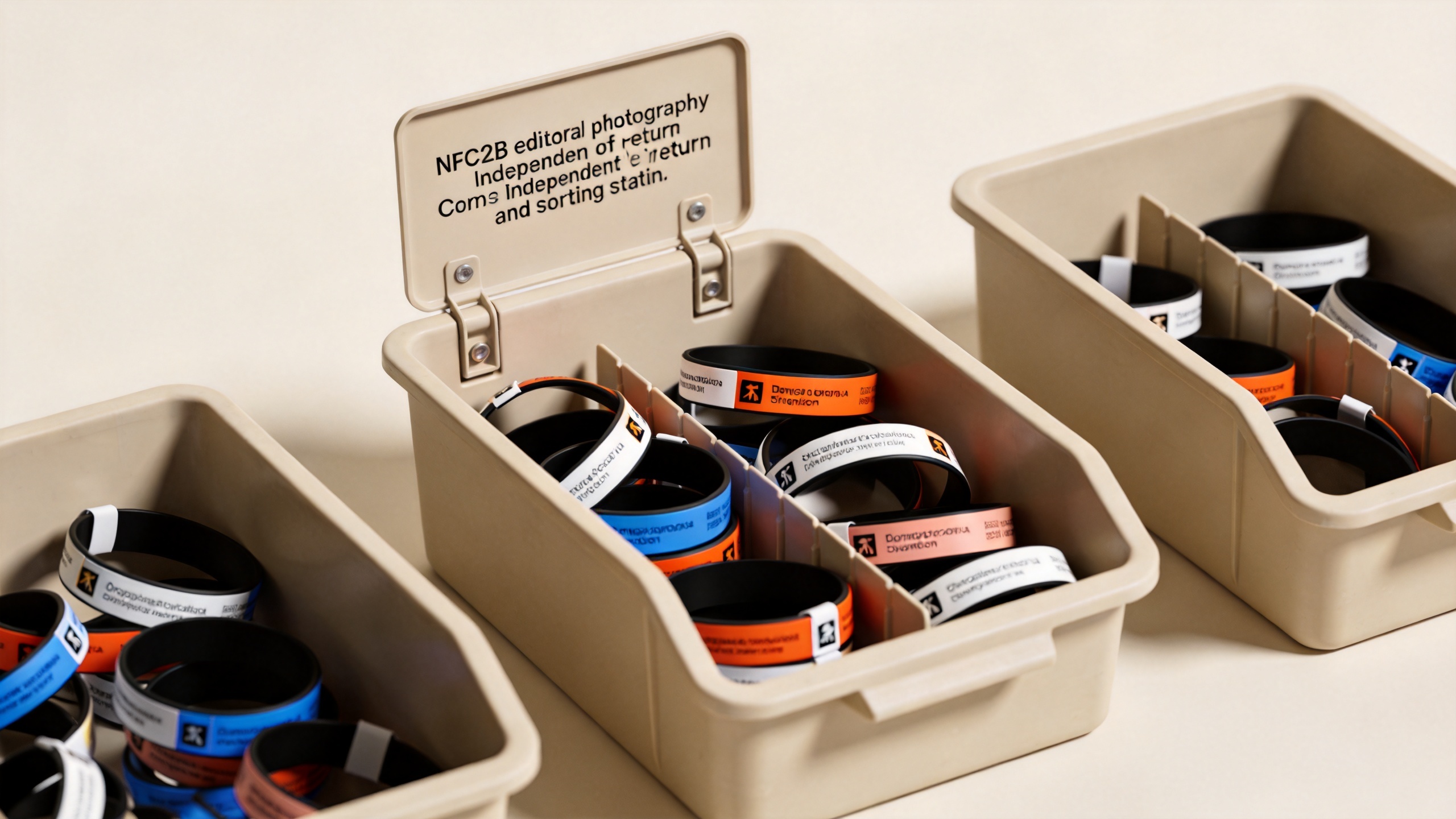
A practical procurement checklist
Before ordering NFC wristbands for events, bring operations, sustainability, IT, and procurement into the same conversation. A supplier that works across RFID, NFC, and UHF wristband formats can help buyers compare compatibility requirements, but the final selection must reflect the reader system and the event plan.
- Confirm the workflow: Which paper or plastic items will the wristband actually replace?
- Specify performance: Test chip compatibility, read behavior, durability, fastening, and water exposure in the intended setting.
- Ask material questions: Request documented composition, recycled-content evidence where relevant, and realistic reuse or recycling instructions.
- Build reverse logistics: Decide who collects, transports, cleans, tests, stores, or processes returned event wristbands.
- Protect data: Define encoding, deactivation, retention, and access responsibilities before deployment.
- Measure a baseline: Record prior quantities of printed tickets, badges, vouchers, replacements, and disposal so future results can be compared.
How to make a defensible carbon-footprint claim
It is tempting to say that NFC wristbands for events “lower carbon footprint,” but responsible communications need a boundary and evidence. Compare the proposed system with the credential process it replaces. Include production, shipping, on-site materials, replacement rate, collection, cleaning, reuse cycles, and end-of-life treatment where data are available. Avoid converting a reduction in paper items directly into a precise carbon number unless a documented lifecycle assessment supports it.
A practical dashboard can include credentials issued per attendee, replacement rate, paper items eliminated, return rate, bands successfully redeployed, and disposal route by material. These indicators do not substitute for a carbon assessment, yet they show whether the operating model is moving toward source reduction and reuse. They also reveal whether event wristbands are being overordered or whether a recovery plan needs adjustment.
Implementation sequence for large events
- Map every attendee credential and decide which functions can be consolidated.
- Pilot NFC wristbands for events at one entrance or event zone, then test read reliability, queue flow, and return behavior.
- Choose a material and fastening style only after the reuse and disposal path is defined.
- Train staff on activation, lost-band handling, collection, and privacy procedures.
- Review the dashboard after the event and use measured results to improve the next order.
Conclusion: design the system, not just the wristband
NFC wristbands for events have the strongest sustainability case when they replace redundant credentials, improve controlled access, and enter a genuine recovery loop. They are not automatically low-carbon simply because they are digital or RFID-enabled. By pairing the right material with tested read performance, clear data governance, and measurable collection and reuse procedures, large-scale event teams can make event wristbands a more resource-conscious part of the attendee experience.