EN
EN
 AR
AR
 CS
CS
 DA
DA
 NL
NL
 FI
FI
 FR
FR
 DE
DE
 EL
EL
 HI
HI
 IT
IT
 JA
JA
 KO
KO
 NO
NO
 PL
PL
 PT
PT
 RU
RU
 ES
ES
 SV
SV
 ID
ID
 SK
SK
 SL
SL
 ET
ET
 TH
TH
 TR
TR
 MS
MS
 KA
KA
 UR
UR
 BN
BN
 MN
MN

What Support Can a Professional Custom RFID Wristbands Manufacturer Offer for an OEM Order?
When an event, venue, or access-control integrator plans an OEM purchase, a wristband is not simply a branded accessory. It has to work with readers, software, attendee workflows, and a delivery schedule. That is why the useful question is not only “Can you print our logo?” but “What support can a custom rfid wristbands manufacturer provide before, during, and after production?”
From an OEM and ODM manufacturing perspective, the strongest support begins by turning an operational requirement into a buildable specification. For an indoor one-day event, the decision may be straightforward. For a multi-day festival, a hospital workflow, or a controlled-access venue, material durability, closure behavior, chip compatibility, and data handling all deserve a more deliberate review.
1. Requirement review before quotation
A professional custom rfid wristbands manufacturer should start with discovery rather than a generic price list. The buyer can share the reader model or existing chip standard, intended use, estimated quantity, wristband material preference, artwork, delivery country, and required date. In return, the supplier should help convert those inputs into a written specification for material, dimensions, color, closure, chip, printing, and packaging.
This review protects against a common OEM failure: selecting a wristband because it looks right, then discovering that its chip protocol does not match the installed reader system. RFID and NFC are related terms, but they are not automatically interchangeable. For example, ISO/IEC 14443 is associated with short-range contactless applications; the exact chip and reader configuration still need confirmation. A manufacturer can support the process by asking for compatibility information early and by documenting assumptions that require customer approval.
That small pause before a quotation often saves more time than an immediate price response. If a buyer needs custom rfid wrist bands for several venues, the supplier should clarify whether one chip configuration truly works across all locations or whether separate versions are necessary.
2. Chip, antenna, and encoding consultation
Technical consultation is one of the clearest ways a custom rfid wristbands manufacturer adds value to an OEM order. The discussion may cover RFID frequency, chip family, memory needs, UID-only use, sector data, EPC data, serialization, and whether the customer or supplier owns the encoding file. The goal is not to push a universally preferred chip. It is to choose a chip that fits the actual access-control, ticketing, cashless-payment, identification, or tracking workflow.
A practical supplier can also identify decisions that should be frozen before mass production: data format, numbering rules, duplicate-handling rules, test-read conditions, and the party authorized to approve the encoding sample. This matters because correcting an encoding error after shipment can become far more disruptive than revising artwork before printing.
Ask for a pre-production sample or documented sample confirmation when the project includes data encoding. The acceptance record should state what is being checked, which reader or software environment is used, and how exceptions are reported. In-line or batch verification may be available, but the buyer should agree on the exact verification scope instead of assuming identical quality-control practices on every order.
3. Custom design and material engineering
OEM support should cover more than adding a logo. A capable custom rfid wristbands manufacturer can help assess artwork placement, Pantone or color references, printing method, variable numbering, QR code placement, surface finish, and packaging labels. For custom rfid wrist bands, the material choice should be tied to the application: PVC can suit many short-duration access uses, while silicone, woven, fabric, or other constructions may be considered when reusability, water exposure, wearer comfort, or tamper resistance changes the requirement.
There is no universally superior material. If the project is a short indoor event, an economical construction may be appropriate. If it involves rain, repeated scanning, several days of wear, or transfer-prevention controls, the OEM brief should specify those conditions so that clasp design and material behavior can be evaluated. Buyers often focus on unit price first; once a closure fails or an unsuitable material reaches a live event, the real priority becomes fit for use.
4. Sampling, approval, and controlled production
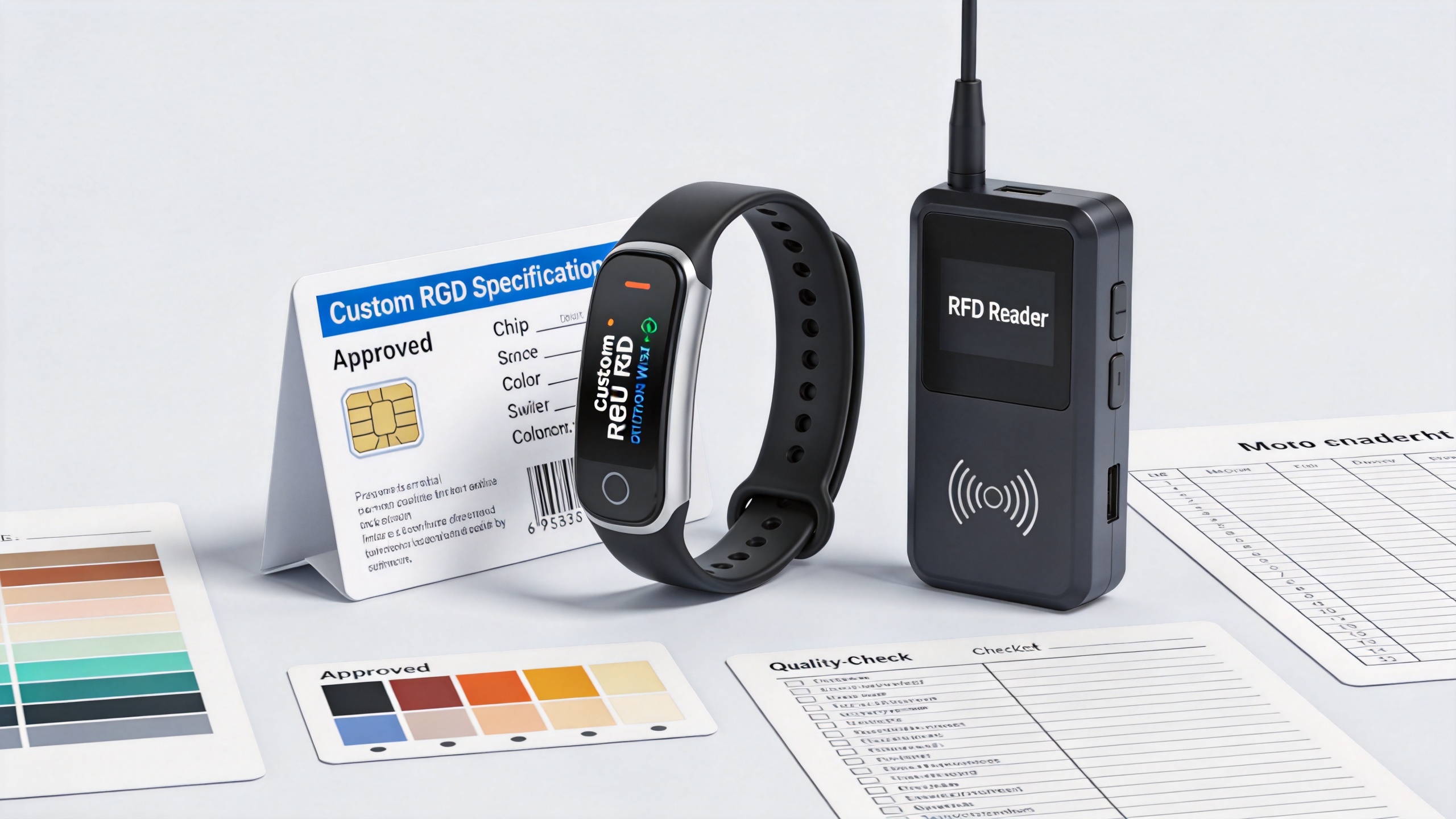
A dependable OEM workflow creates checkpoints. Before volume production, the customer should be able to confirm key visual and functional elements: chip selection, artwork, color, size, closure, encoded-data sample where applicable, and packaging details. A custom rfid wristbands manufacturer can organize that information into an approval list so verbal changes do not become ambiguous production instructions.
During production, useful support includes traceable artwork versions, quantity confirmation, agreed inspection points, and timely notice if an approved requirement needs clarification. For a high-volume order, it is sensible to define an overage or spare-unit approach, especially when on-site replacement is difficult. The exact allowance should be agreed by the buyer and supplier rather than assumed.
5. Quality support that aligns with deployment risk
Quality control should reflect the risk of the job. A branded wristband that does not read at a gate can create queues, manual checks, and avoidable frustration. A professional manufacturer can support OEM buyers by aligning inspection with the order’s critical features: print legibility, color reference, physical construction, closure operation, chip response under agreed conditions, encoded-data checks, and packing accuracy.
The important boundary is this: a supplier should not promise an unverified read rate or reader range. Read performance depends on chip type, antenna design, reader settings, interference, placement, and the real deployment environment. For critical installations, pilot testing with the intended reader system is more useful than relying on a broad marketing claim.
6. Documentation and export coordination
For international sourcing, OEM support also includes clear commercial and shipment communication. Chengdu Mind IOT Technology CO., LTD is located in Chengdu, China, and its site presents RFID, NFC, and UHF wristband categories for access-control and event scenarios. A buyer should still confirm the documentation, production schedule, shipping method, destination requirements, and responsible contacts for the specific order.
A manufacturer can make purchasing easier by keeping the final specification, approved artwork, packing marks, and shipment requirements aligned. This is particularly useful for repeat programs, where the right partner is not just producing one batch but helping prevent version drift between events or purchase cycles.
What to send with an OEM inquiry
- Your application and the reader or platform already in use.
- Target quantity, required delivery date, and destination country.
- Preferred material, wristband dimensions, closure type, and durability conditions.
- Artwork files, color references, variable-data requirements, and packaging instructions.
- Chip or encoding requirements, plus a test or approval process for critical data.
Choose support, not just a unit price
A suitable custom rfid wristbands manufacturer for an OEM order is one that helps uncover the constraints that affect a live deployment: compatibility, construction, data encoding, approvals, inspection, and logistics. The manufacturer does not replace the buyer’s system integrator or event operator. Instead, it provides a disciplined production path that lets those teams approve the right details before volume manufacturing begins.
For OEM buyers, that is the real benefit of professional support. A clear brief, a confirmed sample, and agreed quality checks make custom rfid wrist bands easier to source and less likely to become an operational surprise at the point of use.