EN
 AR
 CS
 DA
 NL
 FI
 FR
 DE
 EL
 HI
 IT
 JA
 KO
 NO
 PL
 PT
 RU
 ES
 SV
 ID
 SK
 SL
 ET
 TH
 TR
 MS
 KA
 UR
 BN
 MN

Why RFID Water Park Wristband Realize One-Card Multiple-Function Site Management
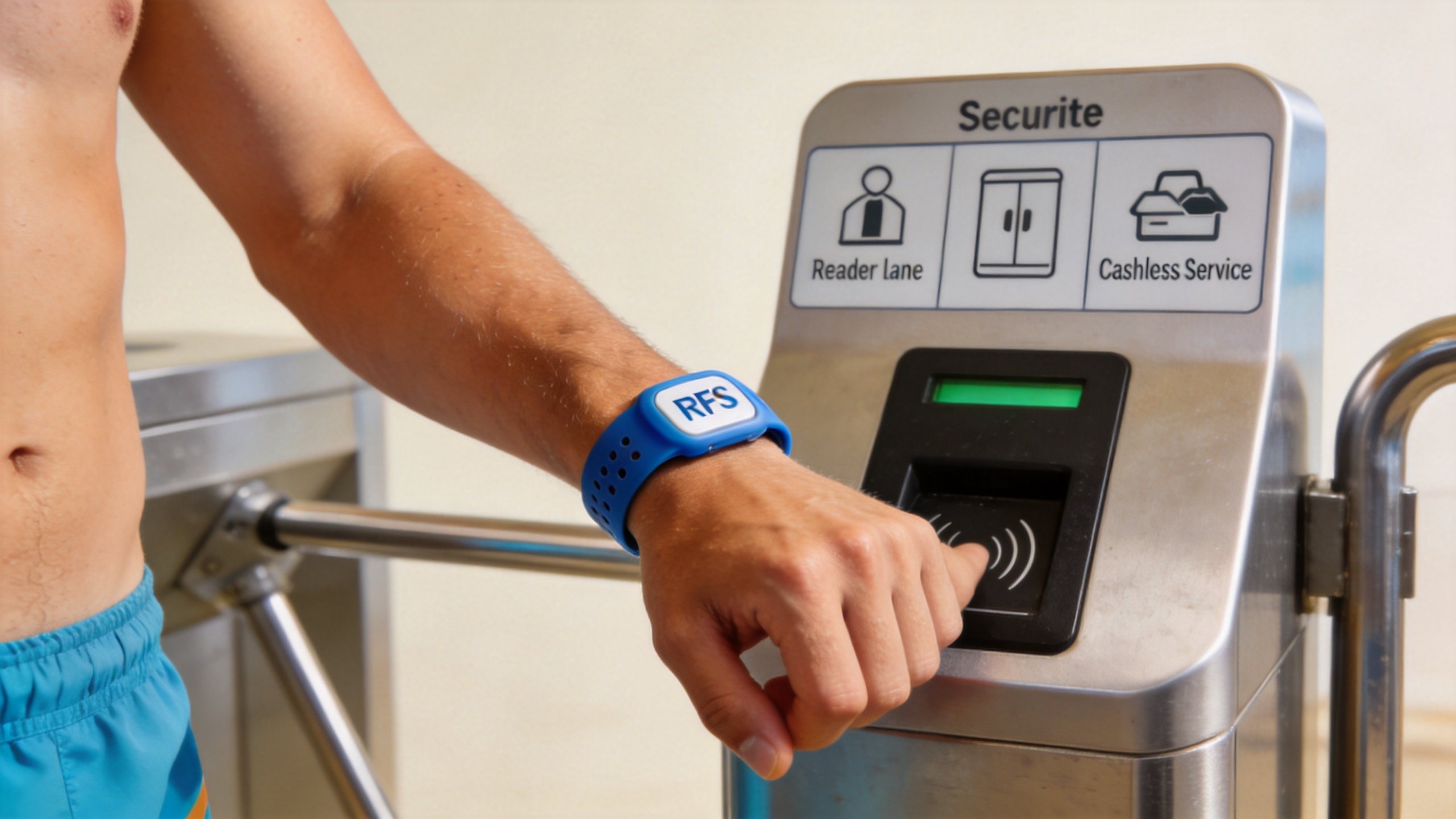
A water park guest does not experience admission, lockers, food counters, cabanas, and exit control as separate systems. They experience one day that should move smoothly. That is why rfid wrist bands for water park deployments are increasingly designed as one credential connected to several operational functions rather than as a simple entry pass.
Having managed access-control planning for busy venues, I know a slow scan at the gate is not a minor inconvenience. In a wet, high-traffic setting, it can become a queue, a guest-service issue, and a distraction for staff. A well-planned RFID wristband system gives each visitor a single identity that authorized systems can recognize at the right moment.
What “one card, multiple functions” means at a water park
The phrase does not mean that the wristband itself performs every task. The band carries an identifier; readers and connected software decide what that identifier is allowed to do. With the appropriate backend configuration, the same rfid wrist bands for water park program can support:
- admission validation at the main entrance;
- access to age-, ticket-, or zone-specific attractions;
- locker assignment and return;
- cashless spending or account charging where the park enables it;
- cabanas, parking, staff areas, and other permission-controlled spaces; and
- lost-band replacement and activity reporting through the same guest record.
The operational value comes from avoiding repeated handoffs between separate tickets, keys, vouchers, and payment tokens. Staff can look up or update one guest identity instead of asking a visitor to carry several items while swimming.
Why the water environment changes the wristband specification
Not every event band is suitable for aquatic use. RFID wrist bands for water park environments need a material, closure, chip placement, and printing method chosen for frequent wetting, sunscreen, chlorine exposure, movement, and repeated scans. The practical question is not simply whether a sample survives a splash. It is whether it remains comfortable, readable, and securely fastened during the full operating day.
Waterproof custom RFID wristbands should be specified around the actual guest journey. A day-pass venue may prioritize quick distribution and a clear visual color system. A resort-style facility with lockers and stored-value spending may need stronger identity handling, replacement procedures, and a closure that reduces casual transfer. There is no universal wristband choice; the right answer depends on the reader infrastructure, feature set, wear time, and security expectations.
How the functions connect behind the scan
1. Issue a unique guest credential
At check-in, staff associate the band’s identifier with a guest or booking record. The record can hold the ticket type, valid dates, eligible zones, locker status, and any payment rules. This is the foundation for rfid wrist bands for water park management: the reader sees an identifier, while the system applies the permissions.
2. Validate entry without treating every scan alike
An entrance reader may only need to confirm that a pass is active and has not already been invalidated. A slide-access reader may need to check height category, package entitlement, or time restrictions. Keeping these rules in the platform rather than printing them on a paper ticket makes changes easier to manage during the day.
3. Tie lockers to the same guest record
Locker use is where a unified design becomes especially visible to guests. After a band is assigned, a locker terminal can link a selected locker to that ID. The same band can later reopen it, subject to the park’s workflow. Staff do not need to issue and recover a separate locker key, and guests do not need to protect one while using water attractions.
4. Enable payment only with clear controls
Cashless payment can reduce the need for guests to carry wallets, but it should be configured with sensible controls. Consider account association, spending limits, refund rules, parental approval, staff override rights, and the process for a reported lost band. The short answer is that one band can support payment; actually, the quality of the operating rules matters at least as much as the chip choice.
5. Use access logs to improve service, not overpromise surveillance
Scan records can help operators identify a blocked gate, a locker issue, or an attraction entrance that needs more staffing. They should be handled according to the park’s privacy notices, retention practices, and applicable requirements. A unified wristband is a tool for service and operations, not a reason to collect more data than the program needs.
Design choices that prevent avoidable failures
Looking at a rated read range on paper tells an operator little about peak arrival. Reader placement, lane spacing, antenna orientation, and how guests naturally hold their wrists all affect the result. If your gates are close together, a longer range is not automatically better; it may create unwanted reads from an adjacent lane. Test the full lane layout with the selected rfid wrist bands for water park before opening day.
Material and closure deserve the same attention. A sample that looks good in a dry office can behave differently after repeated immersion and active wear. When evaluating waterproof custom RFID wristbands, ask for a representative sample run, test the intended reader positions, and confirm how a damaged or lost band will be replaced without creating duplicate access.
- Confirm compatibility with the installed reader and software stack before production.
- Define which functions are active for each ticket or guest category.
- Run a small encoded pilot to verify ID formatting and permission rules.
- Test wet handling, closure comfort, scan positioning, and exception workflows on site.
- Train staff on reissue, refund, and manual-verification procedures.
A practical rollout sequence
- Map the guest journey. List every point where the guest would otherwise present a ticket, key, or payment method.
- Define the credential rules. Decide what each guest type can enter, unlock, or purchase, plus what happens when the band is lost.
- Match the band to the environment. Choose rfid wrist bands for water park use based on water exposure, closure needs, branding, and reader compatibility.
- Pilot before scale. Validate encoding, reader behavior, and staff procedures with a controlled batch rather than discovering issues during peak entry.
- Measure exceptions. Review rejected scans, replacement requests, locker issues, and transaction disputes to improve the next operating cycle.
Conclusion: a wristband is part of a service system
One-card multiple-function management succeeds when the physical band, reader setup, permissions, staff workflow, and guest communication all work together. RFID wrist bands for water park applications can simplify a guest’s day by combining admission, access, lockers, and payment-related workflows into one wearable credential. Start with the journey and the exceptions, then select waterproof custom RFID wristbands that fit the actual site conditions rather than relying on a generic event-band specification.