EN
 AR
 CS
 DA
 NL
 FI
 FR
 DE
 EL
 HI
 IT
 JA
 KO
 NO
 PL
 PT
 RU
 ES
 SV
 ID
 SK
 SL
 ET
 TH
 TR
 MS
 KA
 UR
 BN
 MN

Why Resorts Should Replace Disposable Products with Eco-Friendly RFID Wristband
A resort credential looks small until it becomes a daily operating cost. Paper tickets, single-use plastic bands, and room cards can solve a narrow access problem, but they also create repeat purchasing, handoff friction, and a visible waste stream. For resorts reviewing hotel wristbands, the more useful question is not simply “Which band has the lowest unit price?” It is “Which credential fits our guest journey, access system, recovery process, and material goals?”
From a procurement perspective, reusable RFID wristbands deserve that wider comparison. They can combine identification and selected access permissions in a wearable format, while an eco-friendly material choice can reduce dependence on throwaway products. The result is not automatic: chip compatibility, cleaning procedures, guest communication, and retrieval all need planning. But for multi-day properties, that planning can turn a consumable into a managed operational asset.
Disposable credentials solve the first-day problem, not the full stay
Disposable bands remain convenient for day passes, short events, or a temporary crowd-control need. They are quick to issue and easy to recognize. The trade-off is that a resort buys, distributes, and discards the same function repeatedly. When guests move between a pool, spa, beach, kids’ club, lounge, and accommodation area, staff may also need to visually inspect several types of credentials or manage separate tokens.
That is why hotel wristbands should be evaluated as part of the property’s service design. A properly configured RFID wristband can carry a unique identifier that an approved reader uses to recognize an eligible guest. Depending on the connected system and the permissions assigned, the same wearable credential may support controlled access to amenities such as private beaches, gyms, spas, or VIP areas. It should not be described as a universal substitute for every lock or payment workflow; compatibility with the existing RFID frequency, reader, software, and security rules must be verified first.
What “eco-friendly” should mean in a resort wristband decision
Eco-friendly RFID wristbands are not a single material category. The term should prompt a sourcing conversation rather than serve as a marketing shortcut. A resort can ask whether a proposed material is reusable, what care it tolerates, whether supplier documentation supports any recycled or bio-based content claims, and how the property will handle the band at end of life. Those answers matter more than a broad green label.
A practical comparison starts with lifecycle fit. For a one-day festival inside a resort, a low-cost disposable band may still be appropriate. For a multi-night all-inclusive stay, a durable, recoverable band may reduce the number of credentials consumed over time. Reuse only delivers that benefit when guests return the bands, the property can inspect and sanitize them where appropriate, and staff can retire damaged units without confusing them with active credentials.
Why RFID changes the role of hotel wristbands
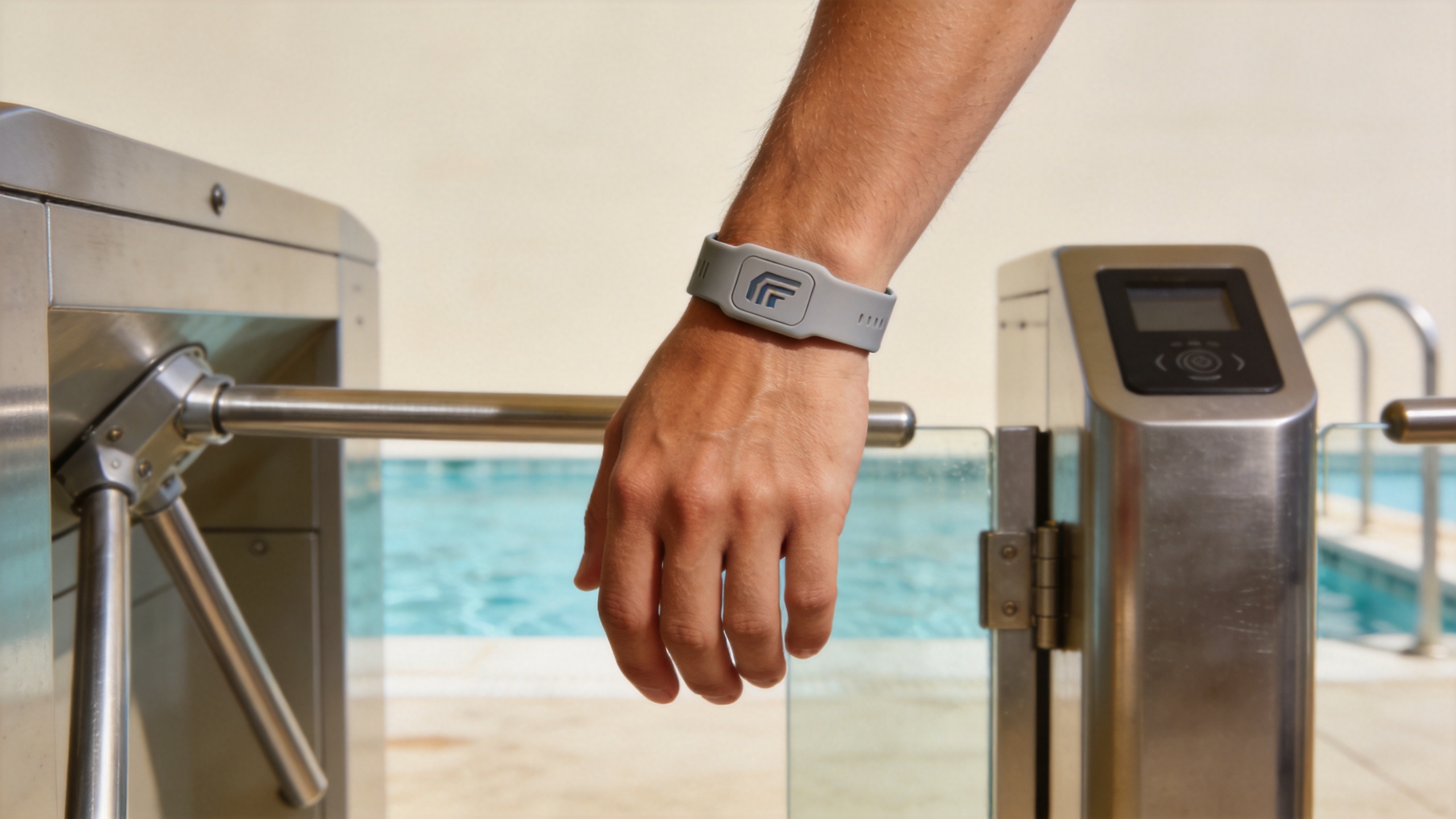
Traditional visual bands mainly signal that a guest belongs in a particular area. RFID adds the possibility of a digital identity. Instead of relying entirely on color or printing, a reader can check whether the identifier presented has the right permission at that moment. This can simplify controlled entry and help operations design a more consistent handoff between guest-facing teams.
For example, a resort might use RFID wrist bands to distinguish an overnight guest from a day-pass guest at a pool gate, or to limit a premium amenity to a defined guest category. The value is operational clarity, not surveillance for its own sake. Data collection should remain proportionate to the service, governed by the property’s privacy practices, and limited to what the integrated system actually needs.
RFID also calls for a different procurement checklist. Ask which chip family and frequency the current readers support, whether encoding is handled before shipment or on site, how a lost band is deactivated, and who owns the credential data. An attractive material without system fit creates a new source of exceptions at the front desk.
A decision framework: disposable band, reusable band, or RFID wristband?
| Decision factor | Disposable credential | Reusable RFID wristband |
|---|---|---|
| Suitable stay pattern | Single-day or temporary use | Multi-day stays and repeatable guest journeys |
| Access method | Usually visual verification | Digital ID when paired with compatible readers and software |
| Material planning | Focus on issue-and-dispose volume | Focus on durability, recovery, cleaning, and end-of-life route |
| Staff workflow | Simple issue, frequent replacement | Requires encoding, exception handling, and return controls |
| Procurement lens | Unit price and daily volume | Total lifecycle cost and integration readiness |
This comparison is deliberately not a verdict. Some resorts will use both models: disposable bands for a one-off attraction and durable hotel wristbands for resident guests. The goal is to match the credential to the stay pattern rather than forcing one product into every situation.
How to make reusable RFID wristbands work in practice
1. Map the guest journey before choosing a chip
List every place a wristband might be issued, read, checked, replaced, and returned. Include arrival, room access if applicable, pools, wellness areas, recreation, VIP zones, and departure. Then decide which touchpoints actually need RFID. This prevents a resort from paying for complex functionality that no team is ready to operate.
2. Define the return and exception process
A reusable program needs a simple closing loop. Explain at check-in whether the band is returned, retained, or charged if not returned. Give front-desk staff a clear way to deactivate a lost credential and issue a replacement. Inspect returned bands for damage, clean them according to the material supplier’s guidance, and separate units that should not re-enter circulation.
3. Validate material claims and guest comfort
Request samples for water exposure, fastening comfort, print durability, and the cleaning routine the property intends to use. If a supplier describes a material as recycled, bio-based, or otherwise lower impact, request the supporting documentation and make only claims that documentation supports. Comfortable, durable RFID wrist bands are more likely to be worn throughout the stay, which supports a smoother access experience.
4. Pilot with a limited service area
Start with one amenity or guest segment. Track practical measures such as replacement requests, failed reads, return rate, and staff exceptions. A small pilot helps the resort see whether reader placement, guest instructions, or encoding workflows need adjustment before the program reaches the whole property.
The supplier conversation should be technical and operational
When sourcing hotel wristbands, a supplier with experience across RFID, NFC, and UHF wristband categories can help a buyer ask better compatibility questions. Chengdu Mind IOT Technology positions its range around RFID, NFC, and UHF wristband products, so a resort can begin the discussion with the reader technology and intended workflow rather than selecting a finish first. The final specification should still be validated against the resort’s own systems and policies.
Useful questions include:
- Which RFID frequency and chip options match our existing readers?
- Can the wristband be encoded to our required identifier format, and where will encoding occur?
- What cleaning and inspection process is appropriate for the selected material?
- What documentation supports material-content or sustainability claims?
- How should damaged, lost, returned, and retired wristbands be managed?
- Can samples be tested in water-exposed areas and with our real reader hardware?
A better replacement is a planned system, not just a greener band
Replacing disposable products with an eco-friendly RFID wristband can give a resort a more durable guest credential and a clearer route toward reducing repeat-use consumables. The opportunity is strongest when the wristband is selected as part of an integrated process: compatible RFID technology, realistic material claims, a defined return loop, and staff-ready exception handling.
For resorts, the durable choice is often the one that works across the full guest journey. Review the total lifecycle of your hotel wristbands, pilot the operating model, and scale only after the material, access system, and guest experience are aligned.
Questions resort teams ask before making the switch
Can hotel wristbands replace every guest credential?
Not necessarily. Hotel wristbands can be a good fit for amenity access and guest identification, but room-entry, payment, and age-restricted areas may each have separate system, policy, and security requirements. A resort should validate every use case with its lock, reader, property-management, and point-of-sale partners before promising a single credential experience.
Are RFID wrist bands hygienic enough to reuse?
That depends on the material, its condition after a stay, and the cleaning process the resort can consistently perform. Build an inspection and sanitation step into the return workflow. If a band cannot be cleaned or shows damage, retire it rather than placing it back into circulation. This is one reason a durable material and clear supplier guidance matter.
How should a resort measure the change?
Compare band issues, replacement requests, staff exceptions, discarded items, return rates, failed reads, and guest questions before and during a pilot. This shows whether reusable hotel wristbands improve the workflow rather than merely change the material.
What should be included in the first purchase order?
Start with samples and a pilot quantity. Confirm chip type, identifier format, color, clasp, packaging, encoding, testing, and the sustainability language supported by supplier evidence.
A practical checklist for hotel wristbands
Before committing, check that hotel wristbands match reader frequency, access permissions, water exposure, guest comfort, and the return process. Test the chosen RFID wrist bands at real pool gates and reception points, document lost-band deactivation, and train staff on exceptions. Review the order with the same lifecycle lens: will these hotel wristbands be issued, collected, inspected, cleaned, and retired in a repeatable way? When those answers are clear, resort teams can scale hotel wristbands with greater confidence.
For multi-day stays, hotel wristbands may be more than a replacement for disposable products. They can be a durable operating tool. The right RFID wrist bands support that goal only when the material choice, system integration, and guest instructions work together.
Use the pilot to confirm how hotel wristbands perform under real resort conditions, then align procurement terms, encoding rules, and recovery targets before a wider rollout.
In short, choose hotel wristbands for the whole guest journey, not just the check-in desk. Well-planned RFID wrist bands give resort teams a reusable credential they can manage with more consistency.
That approach turns hotel wristbands from a disposable item into a considered part of the property’s access and sustainability plan.
For any final specification, ensure hotel wristbands are tested with the resort’s actual equipment and policies.
A measured launch helps hotel wristbands deliver value without overpromising what an RFID credential can do.
With that discipline, hotel wristbands can support a more deliberate move away from throwaway guest credentials.
Evaluate hotel wristbands on lifecycle cost, comfort, and compatible access workflows before scaling the program.
That is the sensible route to more durable hotel wristbands and more responsible resort operations.
Finally, treat RFID wrist bands as part of a service process, not a stand-alone sustainability claim.
Good planning lets hotel wristbands earn their place in the guest journey.
For each resort, the right hotel wristbands program begins with a small, measurable pilot.
Use that evidence to decide how hotel wristbands should be deployed property-wide.
Well-run hotel wristbands programs balance convenience, durable materials, and access control.
The result is a more thoughtful way to manage hotel wristbands across the resort.
Consider RFID wrist bands when a reusable, compatible credential makes operational sense.
Then put the operational plan behind hotel wristbands before making the change.
That is how hotel wristbands can replace disposables responsibly.