EN
 AR
 CS
 DA
 NL
 FI
 FR
 DE
 EL
 HI
 IT
 JA
 KO
 NO
 PL
 PT
 RU
 ES
 SV
 ID
 SK
 SL
 ET
 TH
 TR
 MS
 KA
 UR
 BN
 MN

Top Real-World Application Scenarios for Woven NFC Payment Bracelets
A woven NFC payment bracelet is most useful when it solves an operational problem, not when it is treated as a novelty. In venues where guests are moving, carrying equipment, swimming, dancing, or managing children, a tap-ready fabric bracelet can make identity, access, and approved cashless workflows easier to operate. The important qualification is that a bracelet is only one part of the system. A payment-enabled program still needs a compatible reader, a secure credential or account model, clear redemption rules, and a tested exception process.
From a deployment perspective, woven construction suits programs that want a softer, more familiar wearable than a rigid badge. The textile format can support visible branding and day-long wear, while NFC provides a close-proximity interaction method. NFC technology operates at 13.56 MHz; in practice, that means reader placement, wrist orientation, and staff guidance deserve as much attention as the bracelet design itself.
What makes a woven NFC payment bracelet different?
A woven NFC payment bracelet combines a fabric band with an embedded or attached NFC component. Depending on the deployment, that component may identify a guest, point to a stored account, validate a prepaid balance, or participate in a payment flow approved by the venue’s payment provider. It should not be described as a bank-payment device merely because it contains NFC. For each project, organizers need to confirm which credential is being used, where value is stored, what the reader accepts, and how lost-band replacement works.
That distinction matters most in busy environments. A thoughtfully designed woven NFC payment bracelet can reduce the need to exchange paper vouchers or repeatedly search for a phone. It cannot, by itself, settle a transaction, prevent every fraud attempt, or replace the payment and access controls behind it.
1. Music festivals and multi-day events
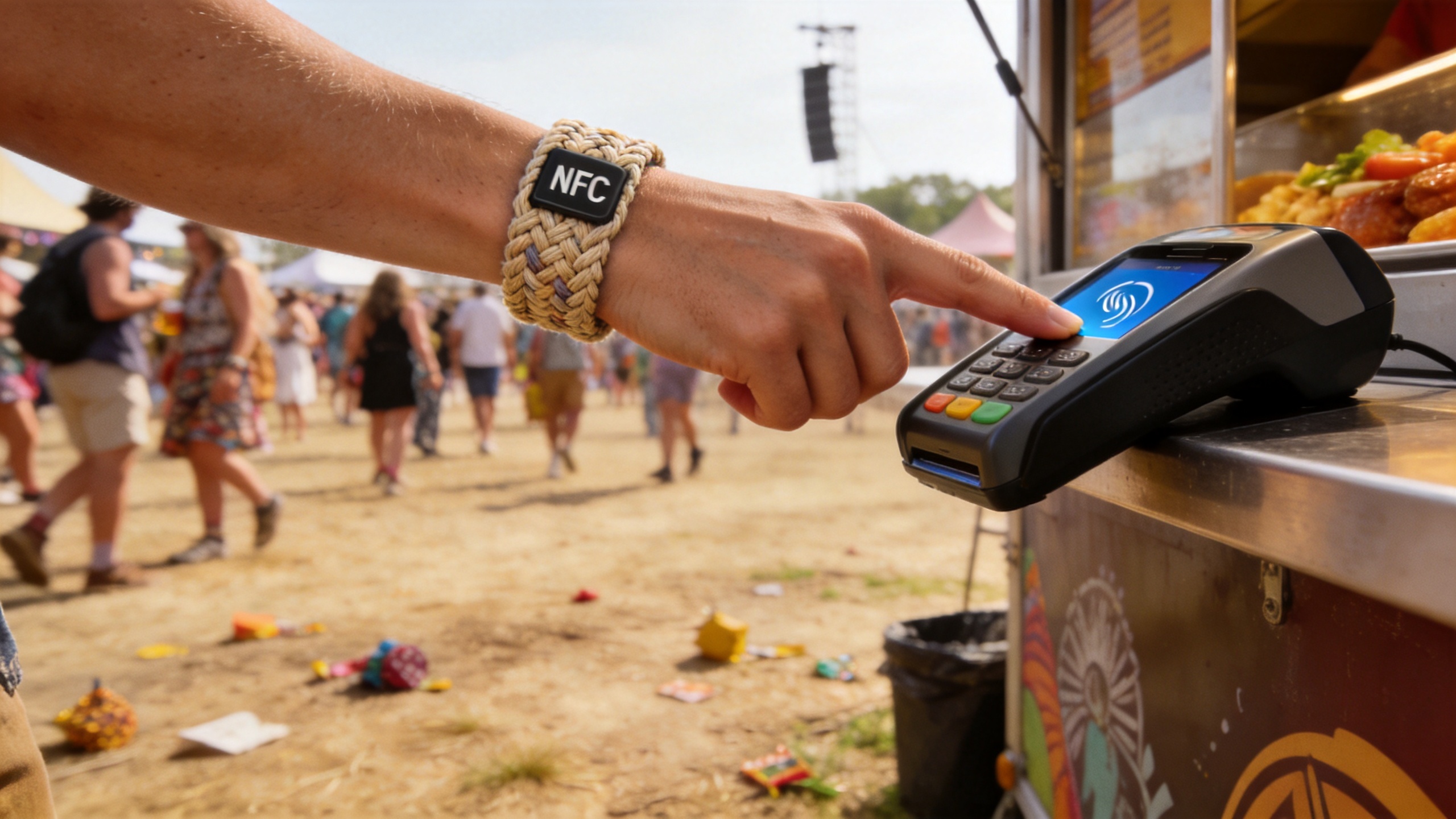
Festivals are the clearest use case for an NFC payment bracelet for events. Guests may arrive with bags, drinks, weather gear, or a group to manage, and vendors face concentrated rushes between sets. A tap at a correctly positioned terminal can be simpler than handling tokens, cash, or a phone at every purchase point.
The strongest model links one wearable to several permitted functions: entry validation, age-gated zone checks where the local rules and system support it, cashless spending, and selected loyalty or merchandise benefits. The bracelet becomes a physical touchpoint, while the back-office system remains the source of truth. Before opening gates, teams should test peak-load behavior, offline or degraded procedures, refund paths, and the process for a guest whose band no longer scans.
2. Sports venues, fan zones, and club hospitality
At a stadium or fan zone, the purchase window is often short: halftime, a pre-match arrival surge, or a break in programming. A woven NFC payment bracelet can support faster guest identification at concession, hospitality, or controlled-access points when it is integrated with the venue’s approved platform. Fabric bands are also comfortable under jackets and can carry team, sponsor, or event graphics without requiring guests to hold onto a separate card.
The design question is not simply “Can people tap?” It is “Which queues should use the tap, what happens when a guest changes seats or membership status, and how will staff spot an exception?” High-traffic venues benefit from a short operating script: where to tap, what success feedback looks like, and when to refer a failed transaction rather than retrying blindly.
3. Resorts, water parks, and cruise-style guest programs
Wet hands, lockers, pool areas, and casual clothing make a wearable especially practical in resort environments. Here a woven NFC payment bracelet can be used to connect a guest to a room folio, prepaid credit, activity booking, or controlled amenity access, subject to the property-management and payment integrations in place. A bracelet may be more convenient than carrying a room key during a swim or family activity, but the material and closure must suit the actual environment.
Operationally, resorts should decide whether a band is issued for the full stay, reissued after loss, or collected at checkout. They should also define who can authorize a linked spend, how family accounts are separated, and whether a child’s bracelet has a different permission set. Those choices improve the guest experience more than an attractive pattern alone.
4. Conferences, exhibitions, and business events
Conferences can use woven wearables for entry, session tracking, catering entitlements, and paid add-ons. An NFC payment bracelet for events may work particularly well for ticketed workshops, cloakroom deposits, or a limited cashless food-and-beverage program. It can also make it easier to distinguish general attendees, exhibitors, speakers, and staff without relying on an oversized badge at every checkpoint.
There is a practical limit: business attendees often need a badge for names and networking. Rather than replacing every credential, a woven NFC bracelet can complement the badge by carrying the tap interaction. That division keeps printed identity readable while making queue-based actions less cumbersome.
5. Corporate campuses and employee hospitality
For campuses, factories, and controlled workplace events, the use case is usually narrower and more governed. A woven NFC payment bracelet can support a temporary cafeteria allowance, visitor catering, wellness-day activities, or employee-only events. It is useful when the organization wants a lightweight, time-bounded credential rather than a permanent access card.
Because workplace deployments touch identity and permissions, administrators should set start and end dates, minimize the data placed on the wearable, and document the support route for lost bracelets. If physical access is involved, the security team should validate the credential technology and revocation process separately from any meal or payment feature.
A deployment checklist before ordering
- Define the role: Is the band for identification, access, prepaid value, account lookup, or an approved payment program?
- Validate compatibility: Confirm chip, encoding, reader, software, and payment-provider requirements before approving artwork or quantity.
- Plan the guest journey: Map issue, activation, tap, failure, loss, refund, and deactivation steps.
- Test the physical experience: Check wrist fit, closure choice, reader placement, and staff visibility in the real venue environment.
- Protect the program: Align transaction controls, credential revocation, privacy practices, and staff training with the operating model.
Choose the scenario before the bracelet
Well-designed woven NFC payment bracelet programs begin with the moment that needs to become easier: getting through a gate, buying refreshments between sessions, entering a booked activity, or identifying the right guest at a service point. Once that moment is clear, organizers can specify the wearable, NFC configuration, artwork, and operational controls around it. For event teams, hospitality operators, and venues, the practical value comes from a complete journey that guests understand and staff can support—not from the tap alone.