EN
 AR
 CS
 DA
 NL
 FI
 FR
 DE
 EL
 HI
 IT
 JA
 KO
 NO
 PL
 PT
 RU
 ES
 SV
 ID
 SK
 SL
 ET
 TH
 TR
 MS
 KA
 UR
 BN
 MN

How Eco-Friendly RFID Wristbands Are Reducing Plastic Waste at Festivals
Festival sustainability is often discussed in terms of cups, food packaging, and transport. Yet the credential handed to every guest can also become a significant stream of short-lived material. Eco friendly RFID wristbands for events give organizers a way to connect entry, access rights, and cashless or engagement functions while reassessing what happens to a wristband after the gates close. The important word is “way,” not “guarantee”: an RFID credential reduces avoidable waste only when its material, security design, collection plan, and disposal route fit the event.
From an event-operations perspective, the decision starts with a practical question: is the wristband a one-day access credential, a multi-day wearable, or a keepsake attendees may retain? That answer changes both the appropriate material and the likely end-of-life outcome.
Why the wristband deserves a place in a festival waste plan
A festival wristband is small, but it is issued at scale. Traditional plastic credentials may be used once, cut off at home, and discarded with general waste. Paper tickets can create a different problem when an event needs reprints, replacements, separate zone passes, or a manual reconciliation process. RFID can consolidate several access tasks into one credential, so eco friendly RFID wristbands for events can help teams avoid duplicating tickets, tokens, and pass types. That operational simplification is a potential source-reduction benefit; it should not be presented as proof that every RFID band is environmentally preferable.
Waste guidance for events generally treats source reduction as a production-cycle decision. In other words, organizers should decide what they will buy, issue, collect, sort, and report before the event opens. Wristbands belong in that same conversation alongside reusable serviceware and vendor packaging.
Material choice comes before the sustainability claim
The term “eco-friendly” is not a material specification. Organizers evaluating eco friendly RFID wristbands for events should ask suppliers for the composition of the strap, clasp, printed layer, RFID inlay, adhesive, and packaging. A recycled-content claim, a biodegradable component, and an item that can be recycled locally are different claims with different evidence requirements.
- Recycled-content or rPET textile options: These may suit festivals that want a fabric feel and a credential attendees may keep. Confirm what portion is recycled and whether the RFID component can be separated or has a defined recovery route.
- Bio-based or biodegradable options: These can be relevant where an approved disposal pathway exists. Verify the exact conditions needed for breakdown rather than assuming a label means the item will decompose in ordinary landfill or mixed-event waste.
- Paper-based formats: These may work for short, low-security applications, but moisture, tear resistance, and the embedded chip design still matter at outdoor festivals.
- Durable credentials: A band intended for return and reuse needs an operational return loop, cleaning or re-encoding process, and a reason for guests to hand it back.
Disposable festival wristbands are not automatically a poor choice. For a high-security, single-entry area, a tamper-evident one-time closure may be necessary to prevent transfer. The more useful question is whether the material and quantity are appropriate for that control requirement, rather than applying one material rule to every zone.
RFID changes the workflow, not just the wristband
When designed well, eco friendly RFID wristbands for events can combine admission, zone permissions, and other approved functions in one credential. That can reduce the need for separate plastic passes or paper vouchers. But RFID also adds an inlay and requires compatibility with the event’s readers and software. Choosing a material first and checking chip compatibility later risks a rushed reorder—an outcome that can create more material waste than the original plan.
Before production, map the credential journey: registration, encoding, distribution, scanning, replacement, collection, and final handling. Test the selected band under real conditions such as rain, sweat, crowd density, and the expected wearing period. A multi-day outdoor festival has different requirements from an indoor evening event, and a band that fails early is not a sustainable purchase simply because its base material sounds greener.
Build a collection plan into the guest experience
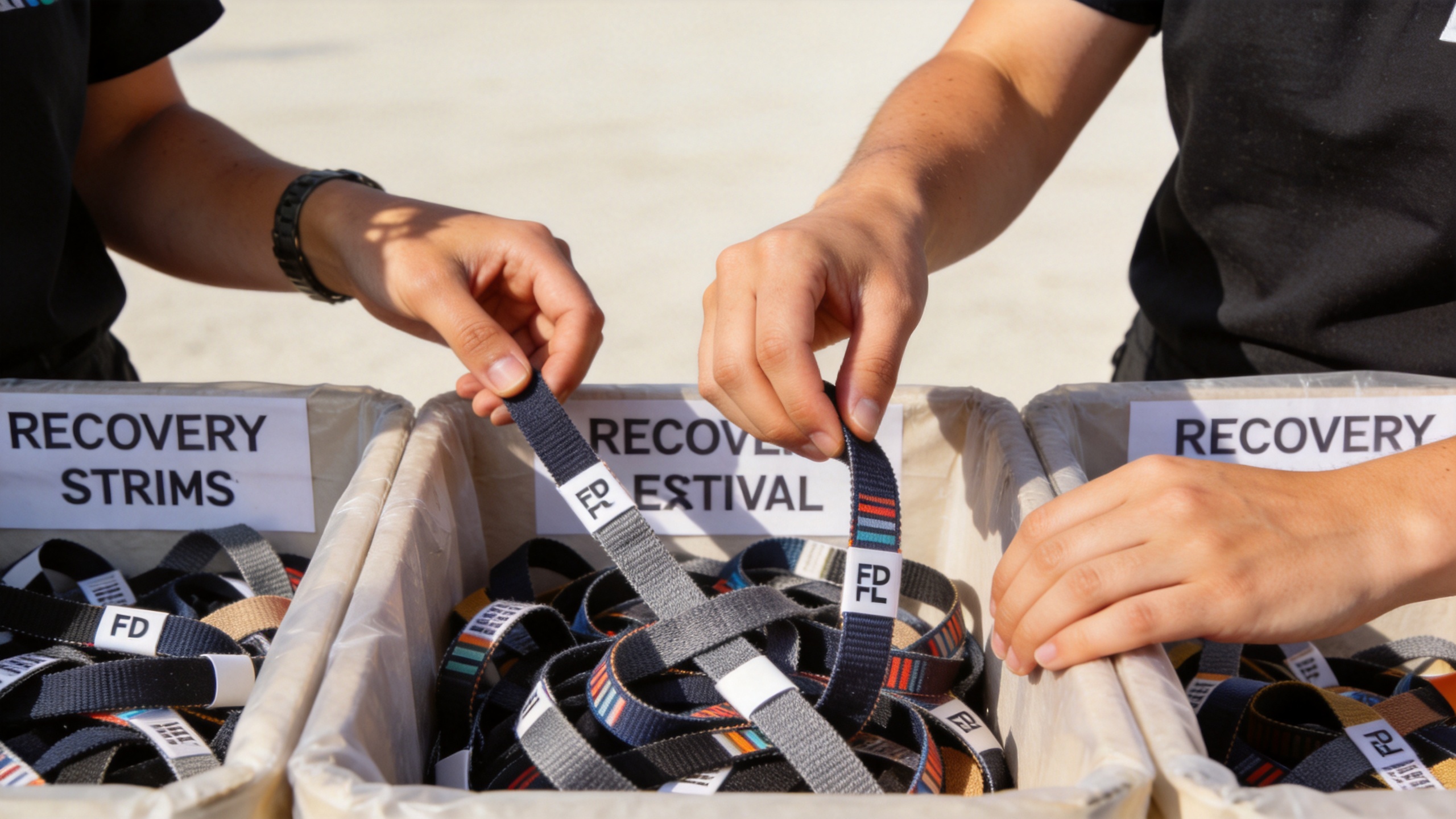
Material selection alone is only half the job. The environmental case for eco friendly RFID wristbands for events becomes more credible when organizers give attendees a clear next step. A return station at exits, a deposit or reward where appropriate, and signage explaining what can and cannot be collected can improve the chance that bands reach the intended stream. If the bands are designed as souvenirs, be transparent that retention is the expected route rather than implying that every kept band is recycled.
Collection also produces useful learning. Track issued bands, replacements, returned bands, and visibly contaminated loads. A post-event review can show whether a return scheme is viable, whether a different closure would help, or whether the next order should use fewer credentials through better registration and access planning.
A practical specification checklist
- Define the access-control and anti-transfer requirement for each attendee category.
- Choose the minimum number of credential types needed; avoid separate bands when one encoded credential can serve the approved purpose.
- Request material-composition, recycled-content, and end-of-life documentation for the complete wristband, not only the strap.
- Confirm chip protocol, encoding workflow, reader compatibility, and a sample test before the production run.
- Match durability to the event duration and weather exposure so premature failures do not cause replacement waste.
- Specify whether the band is disposable, collectible, returned, or recoverable—and communicate that route to guests and staff.
- Measure issuance, replacement, and collection results to improve the next festival’s order.
Make a defensible improvement, not a vague promise
Eco friendly RFID wristbands for events are most effective when they support a broader materials strategy: fewer redundant credentials, fit-for-purpose construction, reliable access control, and a realistic post-event route. Suppliers that offer recycled or biodegradable alternatives can be useful partners, but organizers should request documentation and align the specification with local waste capabilities. The goal is not to call every band “green.” It is to make a better documented choice that protects the guest experience while reducing avoidable plastic and replacement waste.