EN
 AR
 CS
 DA
 NL
 FI
 FR
 DE
 EL
 HI
 IT
 JA
 KO
 NO
 PL
 PT
 RU
 ES
 SV
 ID
 SK
 SL
 ET
 TH
 TR
 MS
 KA
 UR
 BN
 MN

How Silicone NFC Payment Bracelets Handle Frequent Water Immersion in Water Parks
For a water park, a silicone NFC payment bracelet is not simply a soft band with a chip inside. It is a wearable payment credential that must survive queues, slides, splash zones, sunscreen, lockers, repeated handwashing, and the routine of being soaked and dried many times in one operating day. The practical question is not whether silicone feels comfortable in water. It is whether the completed bracelet—its tag, antenna, sealing method, closure, printing, and payment workflow—has been specified and tested for that environment.
That distinction matters because a silicone NFC payment bracelet can look intact while an unprotected electronic inlay, weak seam, or poorly controlled assembly process creates intermittent reads later. Buyers planning cashless water-park access should evaluate the finished device and the deployment process together.
Water resistance belongs to the finished bracelet, not silicone alone
Silicone is often chosen because it is flexible, skin-friendly in normal wear, and well suited to wet recreational settings. However, silicone by itself does not prove that a bracelet is waterproof. The question is how the NFC inlay is placed inside the band and how all paths for water ingress are controlled.
A silicone NFC payment bracelet may use an embedded inlay, an encapsulated module, or a separate tag integrated into a silicone body. Each construction has different weak points. Look closely at the module cavity, the interface between materials, any molded seam, the closure area, and areas where artwork or numbering is applied. Repeated flexing can matter as much as a single immersion because every bend and pull stresses the assembly around the antenna and chip.
Ingress-protection ratings can help buyers compare test claims, but only when the supplier identifies the rating for the actual finished configuration and the stated test conditions. The IEC describes IP ratings as a way of grading an enclosure’s resistance to dust and liquid intrusion. A rating should not be treated as a blanket promise for unlimited pool use, deep-water exposure, chemical exposure, or years of abrasion. Ask what was tested, for how long, at what depth or pressure, and whether the tested sample had the same closure and embedded component layout as the bracelet you intend to order.
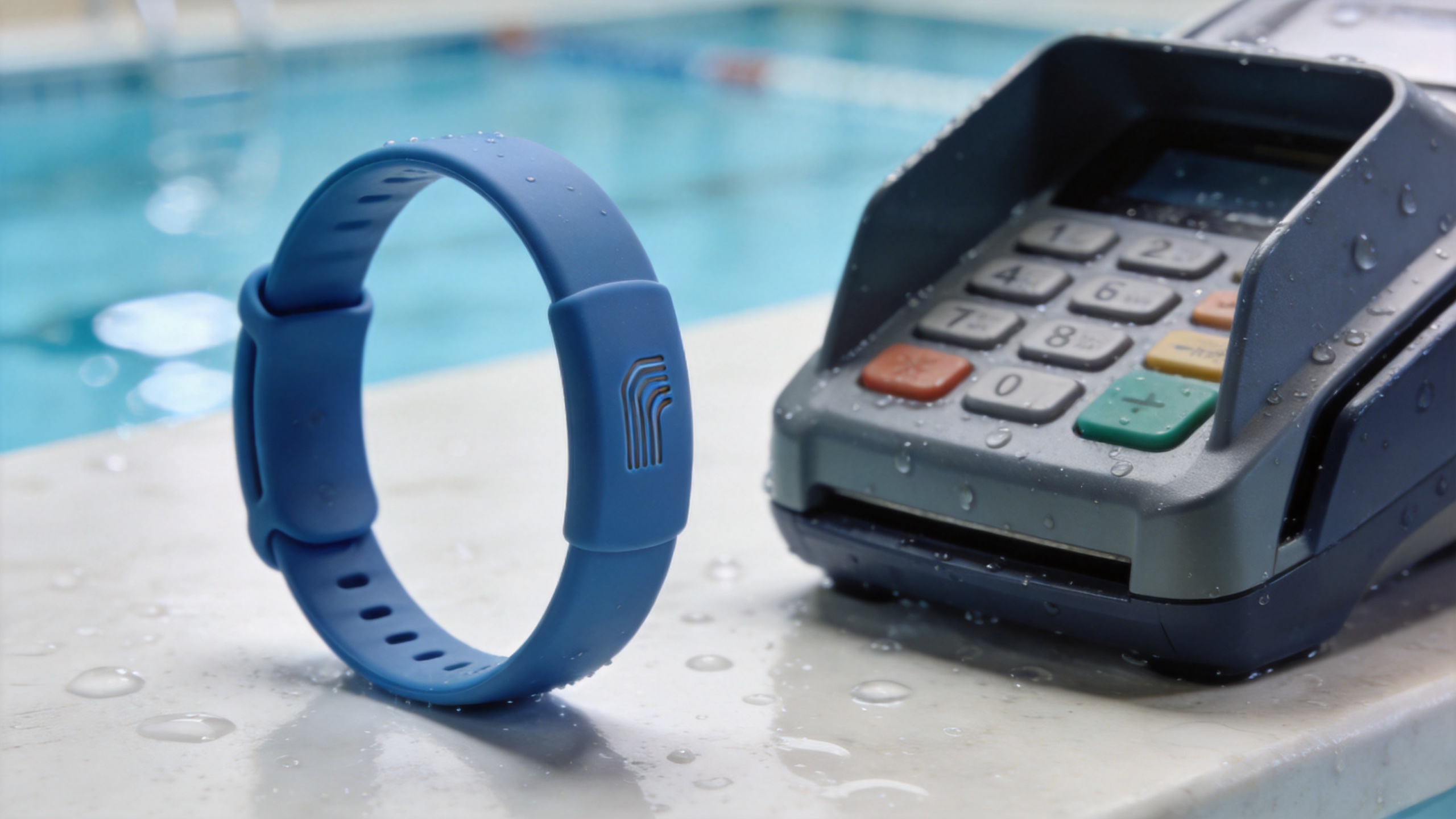
Why immersion does not automatically stop NFC payment
NFC is a short-range contactless technology that operates at a base frequency of 13.56 MHz. In a payment or closed-loop park system, the visitor brings the wristband close to a reader; the reader and credential exchange the information needed by the configured system. Many NFC tags can operate without a battery because the reader field supplies the energy needed for the brief interaction.
Water near the bracelet does not make the system automatically unusable, but it changes the reason to validate real-world performance. A silicone NFC payment bracelet depends on an antenna and chip working together at close range. Moisture can influence NFC antenna behavior, which is why material selection and final assembly should be checked rather than inferred from the appearance of the band. The most meaningful test is not a dry desk scan before shipping. It is a repeatable read test after the representative band has been immersed, dried, flexed, and used in a setting that resembles the park’s reader positions.
Reader placement also affects the visitor experience. A stable, deliberate tap zone at a food counter is different from a hurried tap near a wet locker or rental desk. Staff should know the intended tap location and avoid interpreting every missed read as a bracelet failure before checking reader position, power, orientation, system status, and credential enrollment.
What frequent water-park exposure actually stresses
Water exposure in a park is a cycle, not one event. A guest may enter a pool, walk in sunlight, use a changing area, apply sunscreen, buy food, and return to a ride. Over a season, that creates repeated wet/dry transitions, flexing, rubbing, and contact with personal-care products. A durable silicone NFC payment bracelet should therefore be evaluated against the combined use pattern rather than a single “waterproof” label.
- Sealing and encapsulation: The inlay needs a construction that keeps water away from sensitive interfaces under normal use.
- Mechanical flex: The band must tolerate bending and stretching without shifting, cracking, or damaging the embedded antenna area.
- Closure retention: If a bracelet uses an adjustable or locking closure, it should remain secure when wet and when pulled during active use.
- Surface durability: Printed identifiers, color coding, and guest-facing information need to remain legible after realistic wear and cleaning routines.
- Reader consistency: The payment system should be checked with wet bracelets at the actual counter, gate, or locker reader location.
These are specification and test questions, not assumptions that can be answered from a catalog photograph. A water-park operator should request samples representing the final material, inlay type, size, closure, decoration method, and encoding workflow.
A practical validation plan before a large order
Start with a small pilot rather than relying solely on a generic data sheet. Assign a group of sample units to a simple documented cycle: immersion appropriate to the intended use, drying, flexing, inspection, and a reader test. The goal is not to create a laboratory certification on site; it is to uncover whether the particular silicone NFC payment bracelet and the park’s reader setup work together consistently.
- Define the operating conditions: pools, splash pads, showers, lockers, food service, cleaning routine, expected wearing period, and whether bracelets are single-use or reused.
- Document the finished construction and any supplier-stated water-resistance test. Confirm that the evaluated sample matches the planned production configuration.
- Test representative samples after repeated wet/dry cycles, including a visual check of seams, closure, and print quality.
- Tap each sample at every reader type used in the park, not only at one desktop reader.
- Record failures by symptom: no read, inconsistent read, damaged band, loss of closure, or backend account issue. That separation makes corrective action faster.
This approach also clarifies accountability. A no-read event can come from the credential, the reader, the networked payment platform, encoding, or operational handling. A clear test record prevents the material question from masking a system-integration issue.
Procurement questions that produce a useful answer
When comparing suppliers, replace the broad question “Is this waterproof?” with precise questions. Ask whether the quoted configuration has a completed-device water test; how the NFC inlay is retained and sealed; what flex or pull checks are used; which chemicals or cleaning practices are outside the stated use case; and how each bracelet is functionally checked before shipment. For reusable programs, also ask how the supplier recommends cleaning, inspection, and retirement of damaged units.
It is equally important to separate payment-system requirements from wristband construction. The chip type, memory or credential format, encryption and key-management model, reader compatibility, and enrollment process must fit the park’s selected platform. A well-sealed silicone NFC payment bracelet cannot compensate for an incompatible credential configuration, while a correctly configured credential still needs a physical form factor fit for wet use.
The bottom line for water-park operators
Frequent immersion is manageable when the bracelet is treated as a finished, tested payment device rather than a silicone accessory. Specify the construction, obtain representative samples, validate wet-use tapping at the real readers, and keep claims tied to documented test conditions. With that discipline, a silicone NFC payment bracelet can support a smoother cashless experience while giving operations teams a practical way to monitor reliability over the season.
A waterproof NFC payment bracelet should therefore be treated as a verified system outcome: suitable materials, protected electronics, appropriate testing, compatible readers, and clear operating procedures working together.