EN
EN
 AR
AR
 CS
CS
 DA
DA
 NL
NL
 FI
FI
 FR
FR
 DE
DE
 EL
EL
 HI
HI
 IT
IT
 JA
JA
 KO
KO
 NO
NO
 PL
PL
 PT
PT
 RU
RU
 ES
ES
 SV
SV
 ID
ID
 SK
SK
 SL
SL
 ET
ET
 TH
TH
 TR
TR
 MS
MS
 KA
KA
 UR
UR
 BN
BN
 MN
MN

Why Choose Biodegradable RFID Wooden Wristbands for Sustainable Events?
For an event team, a wristband is not a tiny decoration. It is an access credential, a check-in tool, and sometimes a payment or engagement touchpoint. That is why an eco friendly nfc chip bracelet should be evaluated as an operating component rather than a green-looking giveaway. Wooden RFID formats can help reduce reliance on conventional plastic bands, but the sensible choice depends on the wood component, the strap, the embedded chip, and the way the event will collect and manage bands after use.
From an event-operations perspective, the useful question is not simply “Is wood sustainable?” It is: can this eco friendly nfc chip bracelet work reliably with our readers, survive the venue conditions, and support a disposal plan we can explain honestly? A well-specified rfid wood wristband can answer all three questions. A vague material claim cannot.
Start with the practical problem: plastic convenience versus event impact
Disposable plastic wristbands are familiar because they are easy to print, distribute, and scan. Yet large events can use thousands of them for a short period. A wooden RFID option changes the material story, particularly when the tag is paired with a renewable-fiber strap, but it does not make every component biodegradable by default. The antenna, chip package, adhesive, coating, clasp, and strap may all have different end-of-life paths.
That distinction is useful, not discouraging. It gives procurement teams a better briefing: ask suppliers to identify the material of each component, whether any coating is applied, and what the local recovery route can actually accept. An eco friendly nfc chip bracelet is more credible when its environmental claim is specific about what is wood-based, what is reusable, and what should be separated after the event.
Why wood can fit a sustainable-event brief
Wooden tags offer a tactile, lower-plastic visual alternative for festivals, resorts, conferences, and membership-style experiences. They also create a premium feel without requiring a loud promotional finish. For a guest, the difference is immediate: a small wood token on a fabric strap feels more like a kept item than a disposable admission marker.
That perceived value can support reuse. If a guest keeps the band as a souvenir or returns it at an exit point, the event may reduce the number of single-use items that immediately enter the waste stream. Reuse depends on collection design, token condition, encoding policy, and whether the next event can use the same chip format. Treat reuse as an operational plan, not a material slogan.
Match the chip to the event before choosing the finish
The most common preventable failure is selecting a beautiful band with the wrong technology. NFC and 13.56 MHz RFID are often discussed together, but they are not interchangeable with every access-control setup. A rfid wood wristband may be offered with NFC, high-frequency RFID, or UHF options. Your chosen chip, memory configuration, and encoding method must match the readers and software already deployed at the venue.
Before approving an eco friendly nfc chip bracelet, confirm four items with the event technology team:
- the reader frequency and supported chip families;
- whether the band will handle identity, access, cashless payment, lead capture, or a simple URL tap;
- how identifiers will be encoded, tested, and protected from duplicates; and
- what scan distance and orientation are realistic at gates, bars, or busy registration desks.
Ask for pre-production samples and test them against the actual reader hardware. A material change should not become a queue-management problem on opening day.
Compare the decision factors side by side
| Decision factor | What to verify | Why it matters |
|---|---|---|
| Wood component | Wood type, finish, engraving or print method | Defines look, durability, and how precise a sustainability statement can be. |
| Strap and closure | Fiber type, adjustability, tamper requirement, moisture exposure | A soft strap may suit multi-day wear; a security closure may matter more for ticket control. |
| Chip and antenna | Frequency, memory, reader compatibility, encoding workflow | Determines whether the eco friendly nfc chip bracelet performs in the existing system. |
| Event conditions | Rain, swimming areas, sweat, abrasion, and crowd handling | Wood and straps should be tested for the venue rather than assumed to be event-proof. |
| End-of-event route | Return station, reuse policy, component separation, local disposal guidance | Turns a sustainability intention into a measurable process. |
Use design to make the sustainability message useful
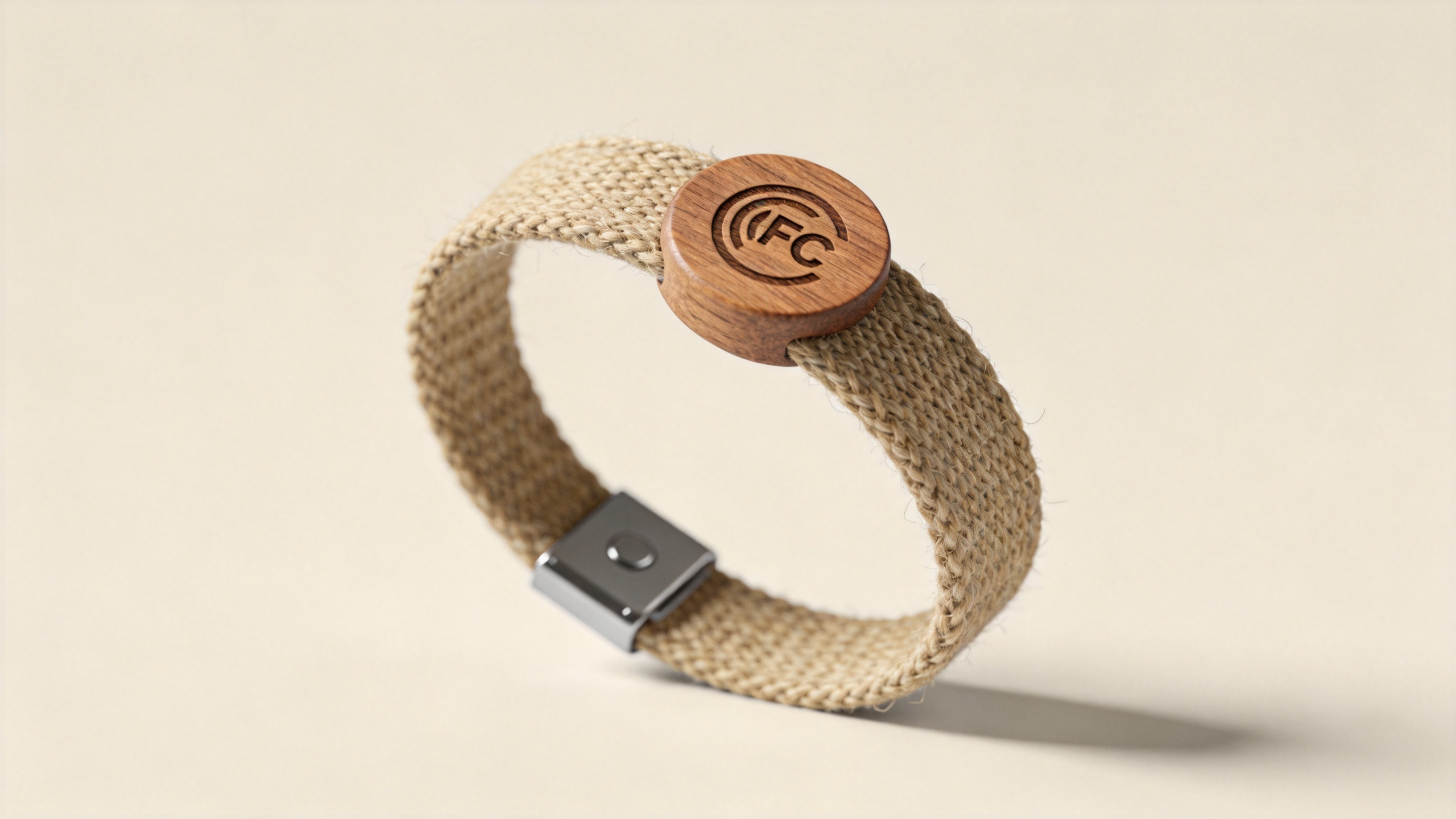
A laser-marked wooden face can carry a logo, zone name, or short return instruction without adding a paper insert. Keep that message practical. “Return for reuse” is more helpful than a broad environmental claim. If the band contains electronic components that cannot enter a local composting stream, say so plainly in staff guidance. Clear language protects attendee trust.
The same approach applies to branding. A restrained mark can make a rfid wood wristband feel intentional while avoiding an overproduced souvenir. For events that use the band as an NFC touchpoint, link the tap action to a useful page: schedules, maps, exhibitor details, or post-event feedback. The better the visitor experience, the more likely the band is to be retained or returned responsibly.
Plan the deployment, not just the purchase order
Small operational details decide whether an eco friendly nfc chip bracelet is a strong choice. Order a quantity buffer for registration changes and damaged items. Keep encoded and unencoded stock separate. Train gate staff on the correct tap or scan motion. For outdoor events, test sample bands after realistic handling, including moisture and sunscreen exposure where relevant.
Then assign ownership for the exit process. A staffed return point, a labeled collection bin, and a reconciliation count give the sustainability claim a practical backbone. If reuse is planned, document which identifiers are cleared and how bands are inspected before the next deployment. If component separation is planned, make the route visible to the team responsible for it.
Frequently Asked Questions
Are wooden RFID wristbands fully biodegradable?
Not necessarily. The wood portion may be renewable or biodegradable under appropriate conditions, while the chip, antenna, coating, closure, and strap may require different handling. Request component-level information before making a public claim.
Will an eco friendly nfc chip bracelet work with any NFC reader?
No. It must be matched to the reader frequency, chip family, software, and encoding process used by the event. A sample test with the actual equipment is the safest procurement step.
When is a rfid wood wristband a good fit?
It can be a good fit when the event values a natural presentation, can validate reader compatibility, and has a realistic plan for reuse, collection, or component-aware disposal.
A balanced choice for sustainable events
Biodegradable RFID wooden wristbands are worth considering when they improve both the attendee experience and the event’s material decisions. The strongest eco friendly nfc chip bracelet is not the one with the broadest claim. It is the one whose chip works at the gate, whose components are clearly specified, and whose return or disposal route is planned before doors open. Use that standard in your supplier brief, and the final choice will be easier to defend to operations teams and attendees alike.