EN
 AR
 CS
 DA
 NL
 FI
 FR
 DE
 EL
 HI
 IT
 JA
 KO
 NO
 PL
 PT
 RU
 ES
 SV
 ID
 SK
 SL
 ET
 TH
 TR
 MS
 KA
 UR
 BN
 MN

How UHF RFID Wristband Support Batch Personnel Reading at Large Resort Sites
At a large resort, a wristband has to do more than open a door. It may identify guests arriving from a coach, help a lifeguard team reconcile people leaving a pool zone, and give operations staff a faster picture of who has entered a restricted service area. That is where uhf rfid wrist bands can be useful: their long-range, passive-read workflow can capture multiple wristbands in a defined read zone instead of requiring every wearer to stop and present a credential one at a time.
As an RFID solutions engineer, I would frame the goal carefully. Batch reading is not the same as granting access. A reader can report a group of tag identifiers; the resort system still needs rules for duplicates, direction, timing, exceptions, and the action that follows. Once those pieces are separated, uhf rfid wrist bands can support a practical people-flow process across a large property.
Why a resort needs batch personnel reading
Resort traffic is uneven. Check-in waves, shuttle arrivals, breakfast rushes, pool openings, staff shift changes, and evening events can send many people through the same corridor within minutes. A close-range tap workflow may be right for a single gate or payment terminal, but it can create friction when an operations team needs a broad, time-stamped view of a moving group.
UHF systems use the 860–960 MHz range defined by the EPC Gen2 air-interface family. In the field, read results depend on local radio rules, reader configuration, antenna placement, tag orientation, the wearer’s body, nearby water or metal, and how long a wristband remains in the read zone. In other words, a claimed range is not a deployment plan. A resort should validate its own lanes before treating a bulk read as an operational record.
A resort workflow: from arrival lane to exception handling
1. Create a defined read zone
Place antennas and readers so the zone matches an actual decision point: a shuttle drop-off lane, a staff entrance, a group excursion return point, or the entrance to a controlled back-of-house corridor. The useful question is not “How far can we read?” but “Where do we need a reliable event?” Narrower, intentional zones make it easier to explain a read and reduce unwanted reads from people nearby.
2. Encode data that the resort can reconcile
Each wristband should carry an identifier that maps to the resort’s authorized guest, employee, or contractor record. The mapping and privacy controls belong in the resort platform; the tag should not be treated as a place to expose personal details. For bulk deployments, request a UID registry file and validate the import before distribution. That makes it possible to trace an unexpected identifier back to the issued batch rather than guessing during a busy arrival window.
3. Filter raw reads into meaningful events
A moving person can be read more than once. A group can include a guest walking beside a staff member. That is normal radio behavior, not necessarily a system failure. Configure a short observation window, deduplicate repeat reads, and combine the result with the reader location and timestamp. If direction matters, use a layout and logic designed for direction instead of assuming that a single antenna can infer it.
4. Route exceptions to people, not alarms alone
Suppose a tour group returns but the expected count and the read count differ. The right response may be a host-led reconciliation list, not an automatic lockout. Likewise, a UHF read near a staff corridor can prompt a supervisor review, while a turnstile or close-range credential check remains the final authority at a high-security door. This distinction is often what keeps a bulk-reading project useful rather than disruptive.
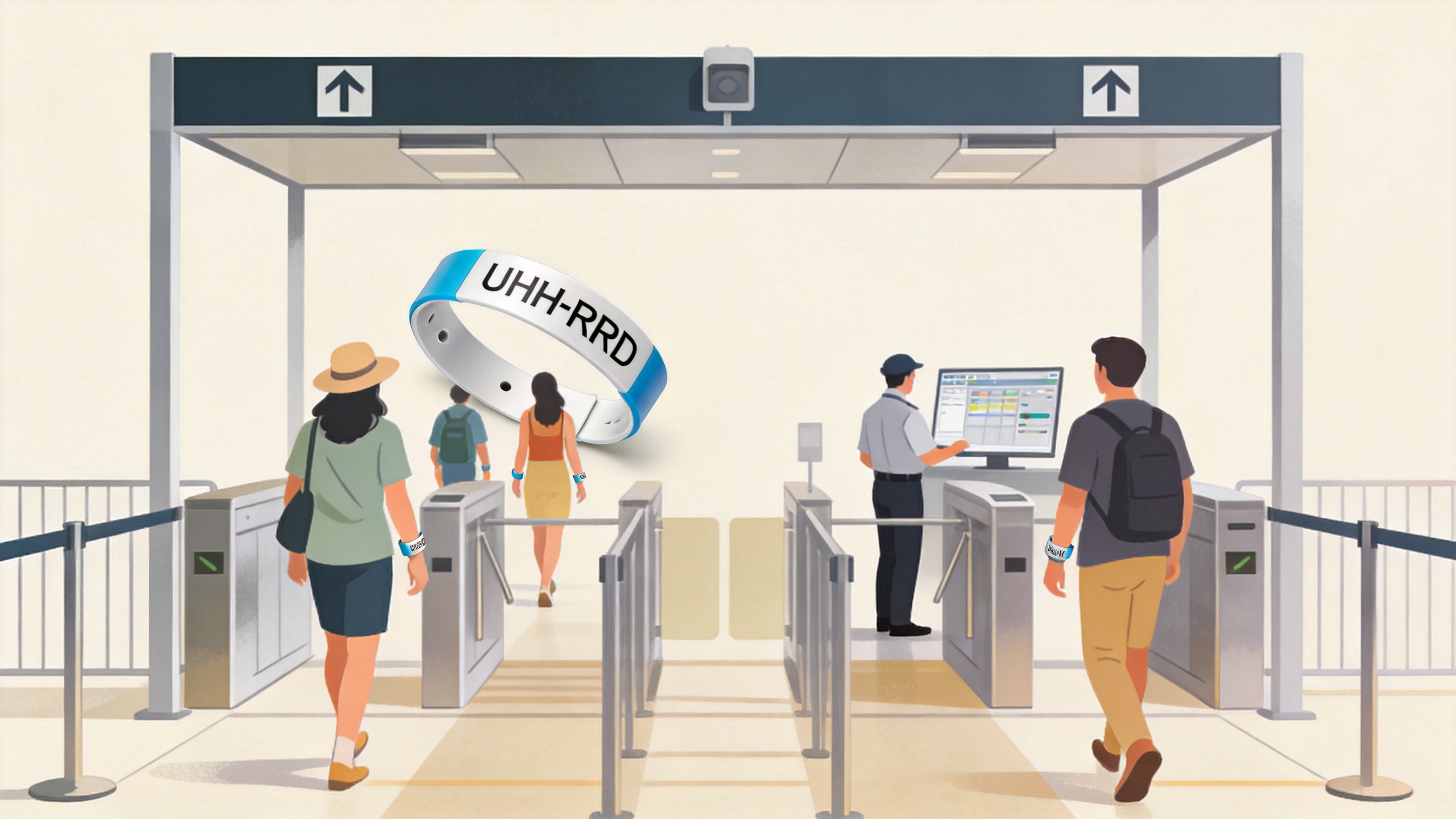
Where uhf rfid wrist bands can support large-property workflows
- Group arrival and departure: compare an expected manifest with a filtered read set as guests pass through a defined arrival or excursion-return zone.
- Pool, beach, and activity coordination: support staff situational awareness at transitions, provided the wristband material and tag position have been tested around wet environments and the human body.
- Staff and contractor movement: record passage through operational checkpoints while retaining a separate, deliberate authorization method for restricted rooms.
- Event overlays: reconcile conference or wedding-party movement at temporary read points without forcing every participant into a single-file scan.
These use cases are why buyers sometimes include rfid wrist bands bulk order requirements early in planning. Quantity matters, but the more consequential questions are chip compatibility, encoding format, material, closure method, allocation by zone, and whether the supplier can preserve a repeatable specification for later orders.
Commission the system before relying on the count
UHF performance around a wrist is sensitive to real operating conditions. A good pilot uses the final wristband material, the intended chip and antenna design, representative wearer positions, and the actual resort environment. Test busy and quiet periods. Test single walkers and compact groups. Test near water, metal fixtures, vehicles, and signage. Then document what “good enough” means for the workflow: an inventory snapshot, a reconciliation aid, or an input to a staffed exception process.
It is also wise to test failure handling. What happens if a wristband is damaged, issued twice, removed, or read at an adjacent zone? What does the front desk see? Who can correct the record? A reliable deployment makes those answers visible before opening day.
A procurement checklist for a bulk wristband program
- Confirm the reader ecosystem and the UHF regional configuration before selecting a tag.
- Define each operational read zone and the event it should produce.
- Specify the wristband material for multi-day resort wear, water exposure, comfort, and intended reuse or disposal.
- Agree on identifier encoding, UID registry delivery, data handling, and test acceptance criteria.
- Separate bulk-read awareness from the final access-control decision at sensitive doors.
- Approve samples in the installed reader layout before placing the full rfid wrist bands bulk order.
- Archive the chip, material, artwork, color, and closure specification so later replenishment matches the pilot.
Deployment matrix for uhf rfid wrist bands
Use this commissioning matrix to make each uhf rfid wrist bands decision traceable. The repeated checkpoints are deliberate: each one tests a different point where uhf rfid wrist bands can produce a useful operational signal.
| Checkpoint | What the resort validates |
|---|---|
| Arrival lane | uhf rfid wrist bands are read only inside the intended guest arrival zone. |
| Shuttle return | uhf rfid wrist bands reconcile a return group against the expected list. |
| Pool transition | uhf rfid wrist bands are tested with wet, moving wearers before rollout. |
| Beach exit | uhf rfid wrist bands are checked for adjacent-zone reads near open walkways. |
| Staff entrance | uhf rfid wrist bands create a time-stamped observation, not an automatic clearance. |
| Service corridor | uhf rfid wrist bands use filtering so repeated reads do not inflate counts. |
| Event tent | uhf rfid wrist bands are tested with a compact group, not just a single wearer. |
| Excursion return | uhf rfid wrist bands support a host-led exception list when counts differ. |
| Reader handover | uhf rfid wrist bands are associated with a documented antenna layout and settings file. |
| Issue desk | uhf rfid wrist bands are matched to a validated issuance and replacement process. |
| UID import | uhf rfid wrist bands are verified against the delivered identifier registry before activation. |
| Material trial | uhf rfid wrist bands are evaluated for comfort and wear over the resort stay. |
| Direction test | uhf rfid wrist bands are not assumed to indicate direction without a designed layout. |
| Privacy review | uhf rfid wrist bands use identifiers linked to protected back-office records. |
| Night operation | uhf rfid wrist bands are checked when staffing and traffic patterns change. |
| Exception desk | uhf rfid wrist bands provide context for a person to resolve, rather than an unexplained alert. |
| Reorder control | uhf rfid wrist bands retain the approved chip, material, closure, and artwork specification. |
| Pilot sign-off | uhf rfid wrist bands move to full deployment only after measured acceptance criteria are met. |
In practice, the matrix avoids a common mistake: asking uhf rfid wrist bands to solve a process problem that has not been defined. It also gives procurement, IT, and operations a common record for a rfid wrist bands bulk order.
Make the wristband part of the operating model
Uhf rfid wrist bands are most valuable when they are designed as part of a resort workflow, not as a stand-alone gadget. The technology can help teams observe movement at scale, reconcile groups faster, and reduce avoidable queues. It does not remove the need for zone design, privacy controls, test data, and a human response to exceptions.
For a large resort, that measured approach is the practical advantage: choose a defined read task, validate it with real people and real conditions, and scale only after the process—not just the wristband—has proved dependable.